
4 Different Types of PMOS (and How to Tell Which One Fits You)

If you’ve been reading about PCOS (now called PMOS) for any length of time, you’ve probably run into the idea that there are different “types.” And honestly? It can feel confusing fast. One article swears there are four types, another lists five, and none of them seem to agree.
Here’s the truth I wish someone had handed me when I was 18 and freshly diagnosed after a ruptured ovarian cyst: there’s no single, universally accepted medical classification that officially divides polycystic ovary syndrome into neat little categories. What actually happens is that some healthcare providers and educators use common PMOS categories to help personalize nutrition and lifestyle strategies.
As a Registered Dietitian who has PMOS myself, I’ve spent roughly a decade walking women through this exact confusion. So in this guide, I’ll explain the commonly discussed PMOS types, how they differ, and why understanding your unique symptoms may help you work with your healthcare team to build an effective, individualized plan.
4 Different Types of PMOS (and How to Tell Which One Fits You)
Before we get into the 4 different types of PMOS, let’s talk about why knowing the differences matters. When you know the why, getting to the “let’s fix this” part of the journey feels much easier.
When you get diagnosed with polycystic ovary syndrome (PCOS), now called polyendocrine metabolic syndrome (PMOS), you and the woman sitting next to you in the waiting room might have completely different symptoms. Yours might be stubborn weight and cravings. Hers might be acne and hair changes. One woman’s symptoms may be driven mostly by blood sugar, another’s by stress or inflammation. Same diagnosis, totally different experience.
That’s exactly why the “types” conversation exists. The reason two women with the same diagnosis can respond to completely different approaches comes down to what’s driving their symptoms underneath.
If you’re interested in getting a head start on understanding your symptoms, take my free “What’s Your PMOS Type?” quiz. It can complement this conversation perfectly.
Are There Official Types of PMOS?
Short answer: not the way most articles make it sound. The four functional types above are educational frameworks, not formal medical diagnoses. What’s actually medically recognized is the diagnostic criteria, not the “types.”
For about 20 years, the diagnosis of PCOS (PMOS) has been based on the Rotterdam guidelines: chronic anovulation, hyperandrogenism (biologic or clinical), and polycystic ovaries on an ultrasound. Two of these three criteria are sufficient for making a diagnosis.
Your provider also has to rule out other explanations, like thyroid dysfunction, endometriosis, cushing’s syndrome, and hyperprolactinemia. Along with this, you may hear your provider refer to a PMOS “phenotype.” This isn’t another way of describing insulin-resistant, inflammatory, adrenal, or thyroid-related PMOS. Instead, phenotypes simply describe which combination of the three Rotterdam criteria you meet.
I get it, it sounds like a lot of information at once. However, the distinction is pretty simple: medical phenotypes describe how your PMOS presents according to diagnostic criteria, while the functional types discussed above are used to explore what type or types may be contributing to your symptoms.
The Most Commonly Discussed Types of PMOS
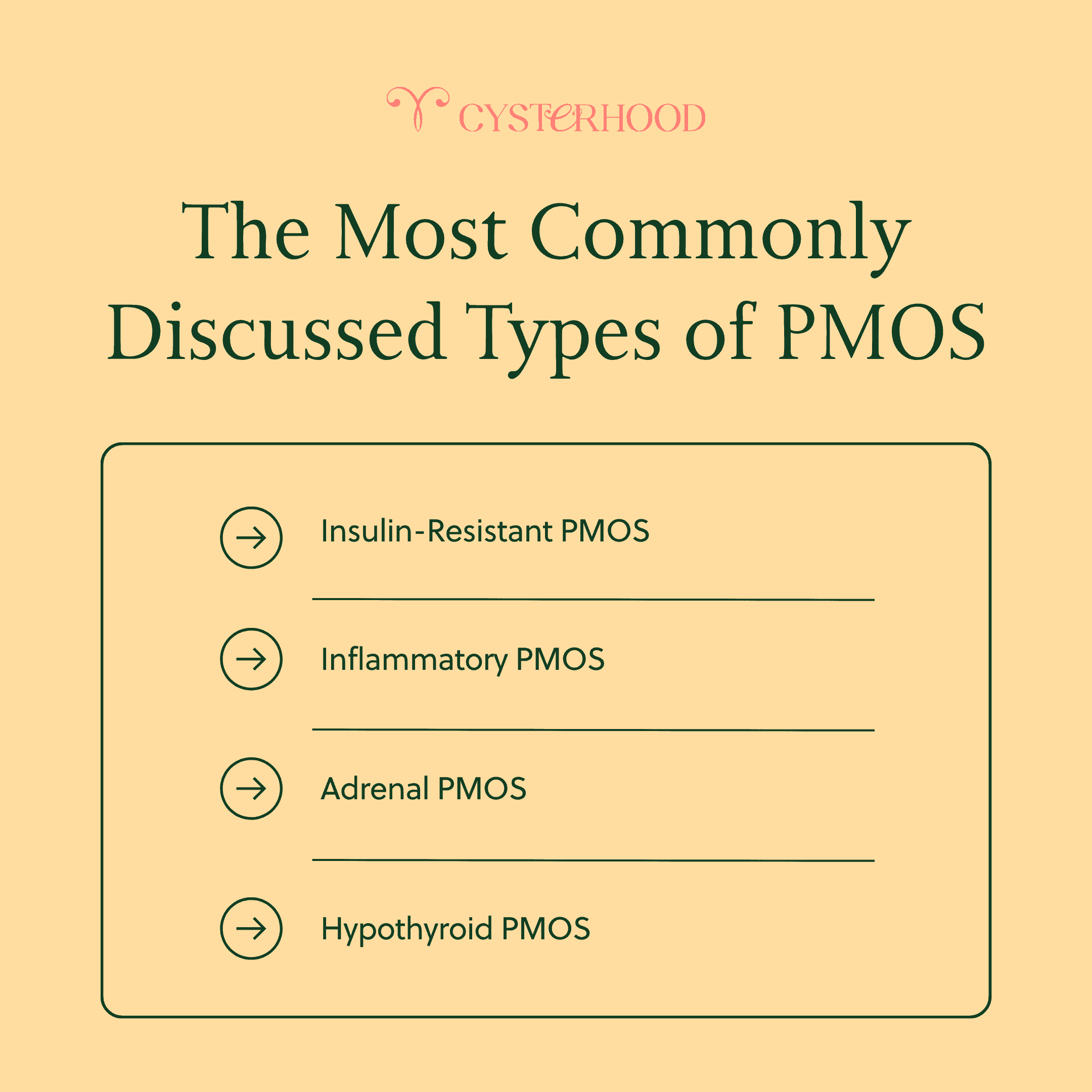
The four types of PMOS most worth understanding are inflammation, insulin resistance, adrenal fatigue, and hypothyroid and most of us have more than one type! Below, I’ll walk you through each one, what tends to drive it, and why the “why” matters for how you’d support it.
Insulin-Resistant PMOS
Insulin resistance is the most common type of PMOS, affecting up to 70% of women with the condition.
Insulin helps move glucose from your bloodstream into your cells for energy. When your cells become less responsive to it, your body compensates by producing more insulin. Those higher insulin levels can then stimulate the ovaries to produce more androgens, contributing to symptoms like acne, facial hair growth, hair thinning, irregular periods, and difficulty losing weight.
This is why I focus so heavily on blood sugar support when talking to other women with PMOS. It’s also why, whenever I discuss nutrition, I recommend starting with a gluten- and dairy-free anti-inflammatory diet that cuts out common triggers.
Inflammatory PMOS
Inflammation is a quieter driver, but it’s worth understanding. The idea here is that chronic, low-grade inflammation disrupts ovarian function and hormone signaling, which can nudge testosterone up and throw your menstrual cycle off.
If inflammation seems to play a role in your symptoms, focus on the basics first. Nutrient-dense foods, consistent low-impact movement, quality sleep, supplements designed for women with PMOS, stress management, and supporting your gut health. When you stay consistent, you may slowly begin reducing symptoms and feeling more like you again.
Adrenal PMOS
Adrenal PMOS is associated with high levels of DHEA-S, an androgen produced primarily by the adrenal glands. While insulin-resistant PMOS centers more heavily on blood sugar and insulin, this pattern has a stronger connection to the body’s adrenal and stress-response systems.
That difference can also shape how you support symptoms. Prioritize sleep, managing everyday stress, and choosing gentle, low-impact movement over constantly pushing your body. These seemingly minor habits can actually play a big role in supporting a balanced stress response.
Testing your DHEA-S levels can also give you and your provider a clearer picture of whether adrenal androgens are playing a significant role in your PMOS symptoms.
Hypothyroid PMOS
Thyroid function and PMOS overlap so much that this one deserves its own spot. When your thyroid is underactive (hypothyroidism), it slows your metabolism, and the symptoms can look almost identical to PMOS. Here’s why the overlap gets so tangled.
PMOS and hypothyroidism can cause similar symptoms, including fatigue, weight changes, and irregular periods. In addition to this, thyroid dysfunction appears to be more common among women with PMOS. Naturally, this can make it difficult to tell which condition is actually contributing to which symptom.
This is why thyroid testing can be such a helpful part of understanding your individual PMOS picture. If hypothyroidism is part of yours, supporting your thyroid alongside your usual PMOS strategies may help address symptoms like persistent fatigue, cycle changes, and difficulty managing your weight.
How Do You Know Which Type of PMOS You Have?
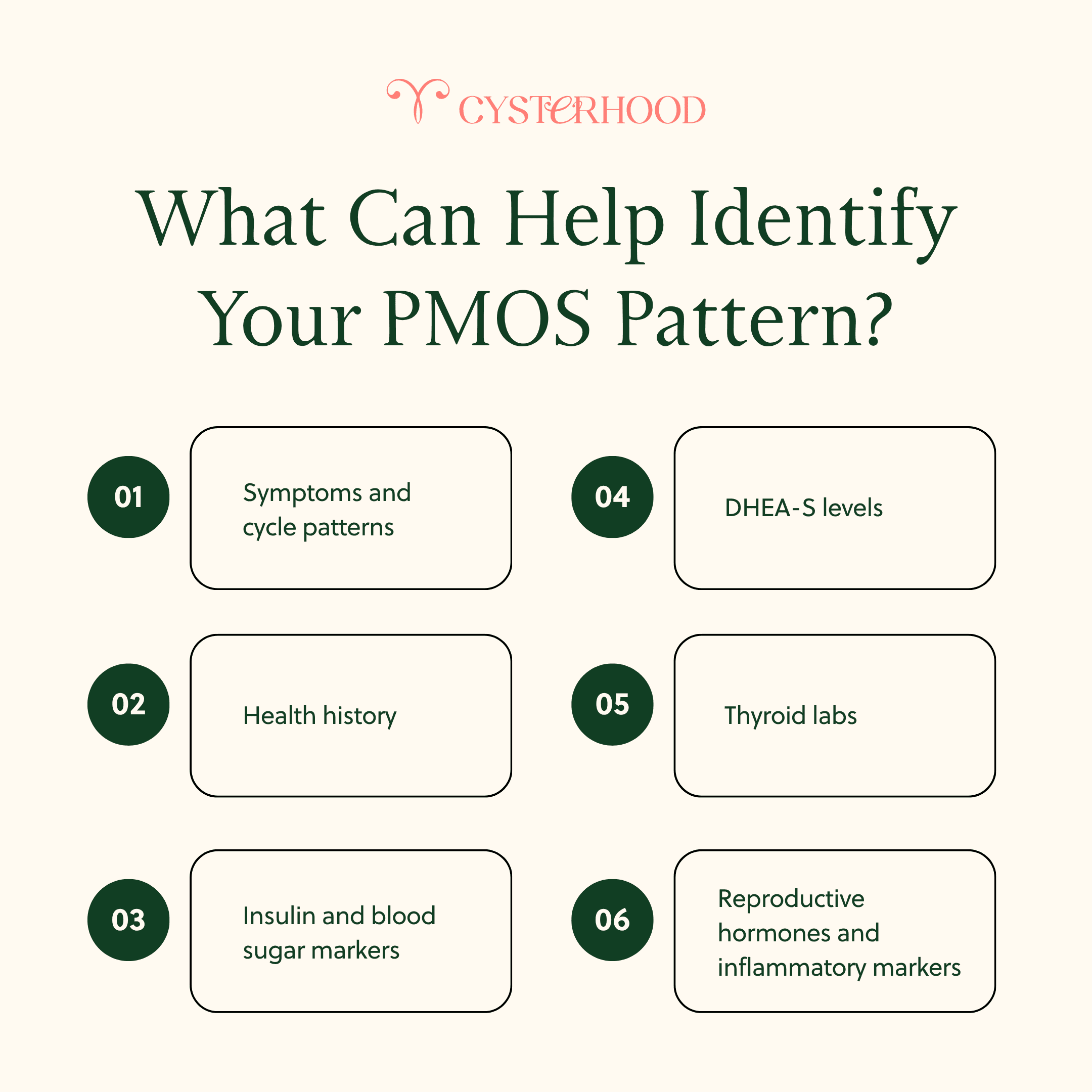
Figuring out your PMOS type starts with looking at the bigger picture: your symptoms, cycle patterns, health history, and lab results. There isn’t one blood test that tells you which type of PMOS you have, but certain markers can help you and your provider understand which patterns may be contributing most to your symptoms.
For example, insulin and blood sugar makers can provide insight into insulin resistance, while DHEA-S can help identify adrenal androgen involvement. Thyroid labs can show whether thyroid function may be part of the picture, while reproductive hormones and, when appropriate, inflammatory markets can provide additional context.
Your symptoms matter just as much. Irregular periods, acne, hair changes, fatigue, weight changes, and other signs can help fill in the gaps that lab results alone can’t.
And here’s what other people may not always admit: birth control pills and dietary supplements aren’t cures for PMOS. While they can offer symptom relief as you’re on them, symptoms generally come right back as soon as you get off. I’m a firm believer that every medication needs an exit plan, which is exactly why I always vouch for controlling PMOS symptoms with natural, sustainable habits that actually move the needle.
When you figure out your PMOS type, managing symptoms can get a whole lot easier.
For most types of PMOS, my starting place is the same one that changed everything for me: a gluten and dairy-free approach, paired with slow, weighted movement, and vitamins and supplements designed for women with PMOS. The “why” is that reducing inflammatory triggers and steadying blood sugar can take pressure off the whole hormonal loop. And, in turn, it may also help with your energy, your cycles, and those relentless cravings.
If you want the meal plans, the workouts, and a community of women who actually get it, download The Cysterhood App. It’s built around this exact method, with gluten and dairy-free meal plans and PMOS-friendly workouts already mapped out for you.
And if you’re not sure where to start? Take the PCOS type quiz and let it point you toward your pattern. It’s the easiest first step, and it’s free. Understanding your PMOS type is how you finally flip the script from “what’s wrong with me?” to “here’s my plan.”
You’ve got this,
Tallene, RD
Medical disclaimer: This content is for educational purposes only and is not medical advice. It is not intended to diagnose, treat, cure, or prevent any condition. Always talk with your doctor or a qualified healthcare professional before making changes to your diet, lifestyle, supplements, or medications, especially anything involving your menstrual cycle, fertility, or prescribed treatment.
Feeling lost with PCOS?
Find out your PCOS type and get your next steps in under 2 minutes.
Find My PCOS Type →