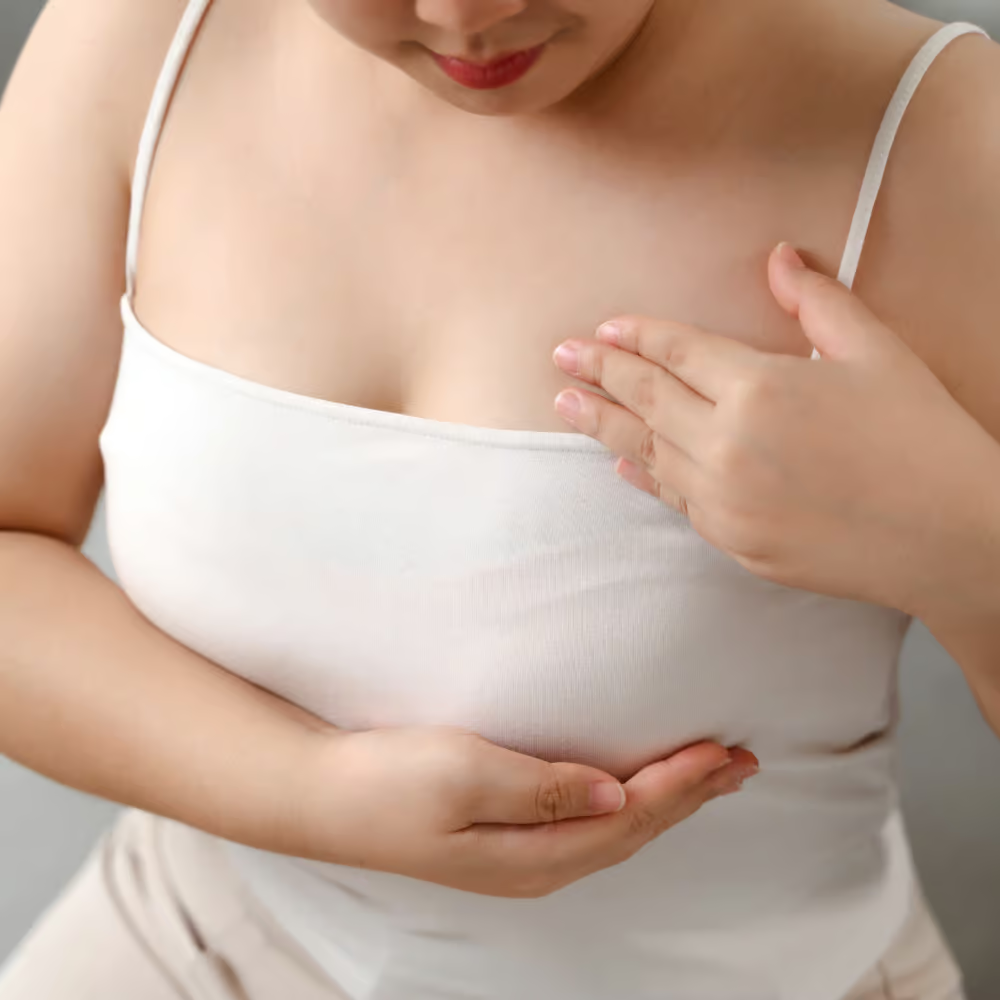

Breasts come in all shapes and sizes, but when yours don’t look like what you expected, it’s easy to wonder why. Maybe they’re narrower than average, sit farther apart, or never seemed to develop a fuller, rounder shape during puberty. If you have PCOS (now called PMOS), it’s only natural to wonder whether your hormones had something to do with it.
These differences can raise a lot of questions, yet we rarely talk about this kind of stuff openly. Tubular breasts in particular are often misunderstood, and it can be difficult to find clear, reassuring information that explains what’s actually happening. That’s exactly why I wanted to dedicate this article to women who have tubular breasts with PMOS. We’ll discuss what tubular breasts are, whether PMOS plays a role in their development, and what you can realistically do if you’re unhappy with their appearance.
Note: You may notice that I use both PMOS and PCOS throughout this article. Polycystic ovary syndrome (PCOS) recently received a new name: polyendocrine metabolic ovarian syndrome (PMOS). I love this update because it better reflects that this hormonal disorder affects far more than just the ovaries. During this transition, I’ll use both names interchangeably to help everyone get familiar with the new terminology.

Tubular Breasts with PMOS: Causes and Natural Treatment
As a Registered Dietitian specializing in PMOS and as a woman living with PMOS myself, I know firsthand that this condition affects so much more than your physical health. Yes, we spend a lot of time talking about how to improve insulin resistance, balance hormones, lose weight, and manage the symptoms that affect our long-term health.
But I also understand that the emotional toll of PMOS can be just as challenging. The way we feel about our bodies, our confidence, and our self-image matters, too. That’s why I’m passionate about creating resources that don’t just address the medical side of PMOS, but also the symptoms that affect how we look and feel. Your mental health with PMOS is just as important as your physical health.
So, if you’re dealing with tubular breasts, I want to break it all down for you today. You deserve answers that help you feel healthier, more confident, and more at home in your own body.
What Are Tubular Breasts?
Tubular breasts, also called “tuberous breasts,” are a natural but unusual breast shape variation that can develop during puberty. They occur when the breast tissue develops within a constricted base, resulting in a narrower, more elongated appearance. Beyond this, research indicates that genetics may play a role in tuberous breast development.
People with tubular breasts may have breasts that look different from average, but the condition itself is harmless. It doesn’t increase your risk of breast cancer or other health conditions. In other words, tubular breasts are simply a difference in how the breast tissue developed, not a sign that something is wrong with your health.
If you’re new to managing PMOS, understanding more about this condition can be a considerable benefit. Take my free quiz, What’s your PCOS Type?, to learn more!
Not sure if you have this issue? Here are the characteristics of tubular breasts:
What Do Tubular Breasts Look Like with PMOS?
Tubular breasts are typically narrow, elongated, and more widely spaced than average. Instead of spreading evenly across the chest wall, the breast tissue develops within a smaller, more constricted area. This creates a narrow base and gives the breasts their characteristic tubular or cone-shaped appearance rather than a full, rounded shape.
Many women also have enlarged or puffy areolas because some of the breast tissue pushes outward through the areola. It’s also common for tubular breasts to be uneven in size or shape, sit farther apart on the chest, have less fullness in the lower portion of the breast, or have a higher-than-normal breast crease. Keep in mind that tubular breasts occur on a spectrum, so some women have only subtle changes while others have more noticeable differences.
Does PMOS Cause Tubular Breasts?
At this time, there isn’t enough evidence to say that PMOS directly causes tubular breasts. Instead, tubular breasts are generally considered a developmental variation that forms during puberty, and genetics are thought to play a significant role. However, because PMOS affects hormone levels during adolescence, some people wonder whether it may influence breast development.
Here’s more on how PMOS may influence tubular breast development:

Why Do You Have Tubular Breasts with PMOS?
Elevated androgens can interfere with breast development.
Up to 80% of women with PMOS have high androgens (male sex hormones). Though we need androgens for things like muscle growth and libido, too much can cause many of the hallmark symptoms of PMOS. Think acne, hair loss, hirsutism, irregular periods, infertility, and mood swings. But it can also affect breast development.
During puberty, estrogen stimulates the growth of the milk ducts and fatty breast tissue. This helps breasts develop their full, round shape. However, when androgen levels are too high, they can interfere with estrogen’s signaling, reducing the breast tissue’s response to this important growth hormone.
At the same time, progesterone promotes the development of the milk-producing glands inside the ducts. But since elevated androgens can prevent ovulation (and ovulation is necessary for progesterone production), progesterone levels often remain too low. Together, these hormonal imbalances can change how your breasts develop during puberty, especially if you’re already genetically predisposed to tubular breasts.
Insulin resistance affects estrogen signaling.
Like androgens, up to 80% of women with PMOS have insulin resistance. This happens when your body doesn’t use glucose properly for energy. To compensate for all the excess sugar in your bloodstream, your pancreas pumps out more insulin, which signals your ovaries to produce even more androgens. (And we already know why that’s not ideal for a woman with PMOS.)
On top of that, high insulin levels lower sex hormone-binding globulin (SHBG). This protein binds to excess sex hormones in your bloodstream to keep them in balance. When SHBG levels drop, more testosterone stays free and active, making your hormonal imbalance even worse.
High insulin also alters insulin-like growth factor-1 (IGF-1), a hormone that drives normal tissue growth and development. During puberty, your breasts rely on IGF-1 and other hormones to guide healthy breast development. When insulin disrupts these growth signals, breast tissue may not develop as expected. In women who are already genetically predisposed to tubular breasts, this may contribute to the characteristic breast shape.

Non-Surgical Correction of Tubular Breasts with PMOS: Is It Possible?
I want to be realistic with you: without surgery, you won’t be able to change your breast structure. That constricted ring of connective tissue at the base of the breast will be there no matter what interventions you do.
That said, improving the underlying hormonal and metabolic imbalances associated with PMOS can still benefit your overall health, even if it doesn’t change your breast structure. (I talk more about this in my guide, “Can PMOS Be Cured?”). You may also be able to take steps to improve fullness, symmetry, size, and the overall appearance of your breasts, even if you can’t change their underlying structure.
Here are the steps you can take:
Build the underlying chest muscles.
The pectoralis is a large muscle that sits directly beneath your breast tissue. As you strengthen it, the muscle becomes thicker and more defined. That extra muscle can push the breast tissue slightly forward while providing a firmer foundation underneath. It won’t create a dramatic transformation, but building your chest muscles can make tubular breasts appear slightly fuller, more lifted, and more symmetrical.
Here are some chest exercises to try:
- Push-ups
- Chest press
- Dumbbell floor press
- Incline dumbbell press
- Chest flyes
- Resistance band chest press
- Resistance band flys
- Modified plank to push-up
- Medicine ball chest pass
If you’re interested in a more comprehensive approach to fitness and PMOS, listen to my podcast episode, “Exercise for PCOS: Top 5 Favorites, Do’s & Don’ts, Sample Plan.” Additionally, I highly encourage you to download the Cysterhood app. Here, you can find PMOS-curated recipes, meal planning, workouts, habit trackers, and live coaching.
Find a really good bra.
To help your clothes fit better and boost your confidence day to day, invest in a good bra. A well-fitting bra can redistribute breast tissue, bring the breasts closer together, and create a fuller, more symmetrical appearance. I recommend getting professionally fitted, or at the very least, looking for a bra with molded cups, side support, and a plunge shape.
Support a healthy body composition.
Your breasts are made up of both glandular tissue and fatty tissue. So, changes in your body composition can also change the size and fullness of your breasts. If you’re underweight, reaching a healthy weight may increase breast volume.
On the other hand, if you’re trying to lose weight with PMOS, focus on preserving muscle while losing body fat to help preserve breast volume as much as possible. Just keep in mind that, yes, body composition can affect breast size. However, it won’t change the underlying connective tissue that’s responsible for tubular breasts.
PMOS & tubular breasts
Tubular breasts are just one of the many ways PMOS can affect your body, and they deserve to be talked about just as much as the more commonly discussed symptoms. I hope this guide gives you a better understanding of why they develop, what role PMOS may play, and what options are available if you’d like to improve their appearance. And, of course, don’t forget to take my free quiz, What’s your PCOS Type?, to learn more about your unique journey! As always, my goal is to help you better understand your body so you can make informed decisions with confidence.
Written by Tallene Hacatoryan, MS, RD, founder and formulator of OvaFit. Tallene is a Registered Dietitian who specializes in PCOS (now called PMOS) nutrition and has PCOS herself.
Medical disclaimer: This content is for informational purposes only and is not intended as medical advice. Always consult your healthcare provider before making changes to your diet, supplements, or treatment plan.
These statements have not been evaluated by the Food and Drug Administration. This product is not intended to diagnose, treat, cure, or prevent any disease.