

Can You Get PMOS Later in Life? Here’s What Research Says

Most of us hear about PCOS (now called PMOS) when we’re younger, whether that’s during our teen years or in our 20s. So when symptoms show up in your 30s or 40s, it feels confusing. Suddenly your cycle is irregular, you’re gaining weight no matter what you do, you’re breaking out or losing hair, and now you’re wondering if you can get PMOS later in life.
I’m Tallene, a Registered Dietitian who specializes in PMOS and was diagnosed with it myself at 18. I know how confusing it can be when your symptoms don’t seem to make sense, which is why this is one of the questions I get most.
PMOS symptoms can become more noticeable later in life, even if you’d had the condition for years and not known it. Let’s talk about why that happens and what it means for you.
Can You Get PMOS Later in Life, or Was It Always There?
A lot of women aren’t diagnosed with PMOS until their 20s, 30s, or even 40s. That usually isn’t because PMOS appeared out of nowhere. It’s because the earlier signs were mild or mistaken for other things going on with their hormones.
An estimated 10 to 13% of women globally are thought to have PMOS, but up to 70% of affected women are undiagnosed. That’s a huge gap, and it’s a big part of why a diagnosis later in life feels so surprising.
When you notice symptoms of PMOS in your late 30s, the better question is “why am I noticing this now?” rather than “why did I just develop this?” For a lot of women, the signs were there all along, they just didn’t know what they were looking at yet.
What Is PMOS (Formerly PCOS)?
Polycystic ovary syndrome (PCOS) is a hormonal condition that we’re now calling polyendocrine metabolic ovarian syndrome (PMOS) to better reflect how it affects the whole body rather than just the ovaries. Despite what the old name suggests, you don’t ACTUALLY need ovarian cysts to have the condition.
At its core, PMOS involves elevated androgens (male hormones like testosterone) and irregular ovulation. It’s closely tied to insulin resistance, which means your cells don’t respond to insulin as well as they should. As a result, your body has to work harder to keep your blood sugar balanced, and that can affect your hormones, ovulation, and metabolism.
That’s why PMOS can show up in so many different ways. Common symptoms of PMOS include irregular or missed periods, weight gain (especially around the middle), acne, excessive hair growth on the face or body, and hair loss on the scalp. Maybe you have several of these symptoms or just a few. PMOS looks a little different for every woman.
How Does PMOS Develop?
Here’s the reassuring reminder you deserve: PMOS isn’t the result of anything you did. Usually, there are several factors working together behind the scenes:
- It often begins in adolescence but goes undiagnosed. PMOS can be especially tricky to spot during the teen years because irregular periods and changes in insulin sensitivity are already parts of puberty. That can make earlier signs easier to miss.
- There’s a strong genetic component. If PMOS, type 2 diabetes, or irregular cycles run in your family, you may be more likely to develop it, too.
- It’s driven by insulin resistance and hormone imbalance. These two can feed into each other. Higher insulin levels can signal the ovaries to produce more androgens, which can interfere with ovulation and your period.
For some women, the signs of PMOS can be there for years before they finally realize they’re really just all connected.
Can You Develop PMOS Later in Life?
True late-onset PMOS, meaning it genuinely develops for the first time in your 40s, is uncommon. PMOS typically begins around puberty, so receiving a new diagnosis during perimenopause doesn’t necessarily mean the condition itself is new.
Most of the time, what looks like PMOS developing later in life is actually a delayed diagnosis. Maybe your symptoms used to be mild, hormonal birth control kept them under control, or you simply didn’t realize that what you were dealing with was related to PMOS at all. As your hormones change with age, those same symptoms become harder to miss.
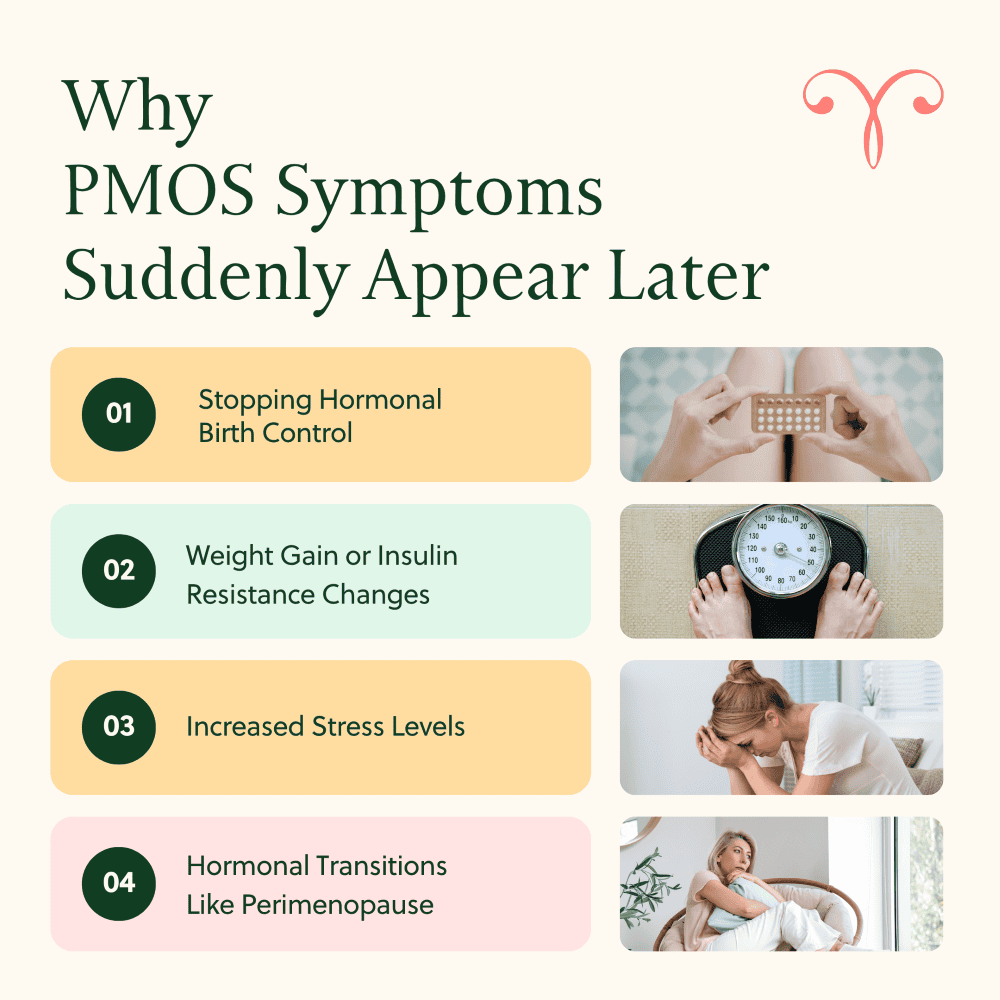
Why PMOS Symptoms Suddenly Appear Later
If PMOS was quietly along for the ride, what makes the symptoms get louder in your 30s or 40s? Usually, there’s been a shift that makes them more noticeable:
Stopping Hormonal Birth Control
Birth control pills work by supplying steady synthetic hormones that override your natural cycle, which can help regulate periods and reduce acne and excess hair growth. It’s not treating PMOS underneath, it’s really just managing the symptoms on the surface. So when you stop, those symptoms may become more noticeable again. This isn’t a reason to avoid or stop your birth control without talking to your doctor, it’s just helpful to understand how it works so the change doesn’t blindside you.
Weight Gain or Insulin Resistance Changes
Insulin resistance is a big piece of PMOS for many women, and it can change throughout your life. Weight gain, especially around the midsection, can make insulin resistance worse, which may also make PMOS symptoms more noticeable.
Higher stress, changes in eating habits, and getting less sleep can all also affect insulin sensitivity. Sometimes, it’s a combination of changes rather than one obvious trigger.
Increased Stress Levels
I talk a lot about stress, and that’s because stress hormones and metabolic health are connected. Chronic stress can affect insulin sensitivity and your menstrual cycle, potentially making symptoms harder to manage. Stress won’t cause PMOS on its own, but for a body already prone to it, a more demanding season may make some of your symptoms more noticeable.
Hormonal Transitions Like Perimenopause
Perimenopause is the years-long lead-up to menopause when your reproductive hormones start fluctuating. It usually starts in your early to mid-40s, though it can begin as early as your late 30s, and it typically lasts around 4 to 8 years.
Some of those hormonal imbalances can overlap with PMOS symptoms. And if you already have PMOS, your symptoms can change as you get older, too. (As I say, it’s one big cycle!) For example, signs of high androgens may become less noticeable with age, while the metabolic and cardiovascular risks associated with PMOS can continue later in life.
How Is PMOS Diagnosed Later in Life?
Getting a diagnosis later isn’t always easy, especially when PMOS symptoms overlap with other hormonal changes happening in your 30s and 40s. There’s no single test that can tell you whether you have PMOS, so your doctor will look at the whole picture: things like your symptoms, health history, and lab results.
If you want a more detailed explanation, I walk through it in my guide, “How is PMOS Detected?” For now, here’s what you can start with:
Blood Tests to Check Hormone Levels
Bloodwork can give you and your doctor a better idea of what’s happening with your hormones and reproductive health. This may include measuring androgen levels (testosterone, DHEAS), luteinizing hormone (LH), follicle-stimulating hormone (FSH), prolactin, and testing for insulin resistance or blood sugar concerns.
Pelvic Ultrasound
An ultrasound gives your doctor a better picture of your ovaries and check for polycystic morphology. But remember: you don’t need polycystic ovaries to have PMOS, and an ultrasound isn’t necessarily included for diagnosis.
Review of Symptoms and Menstrual History
Your symptoms matter just as much as the numbers on your lab results. Your doctor may ask about your menstrual cycles, weight changes, and any new symptoms like hirsutism or acne. This is why if you’ve been with me for a while, you know that I’m always recommending you write down when you started experiencing symptoms. Having that information can make it easier to really explain what you’ve been experiencing.
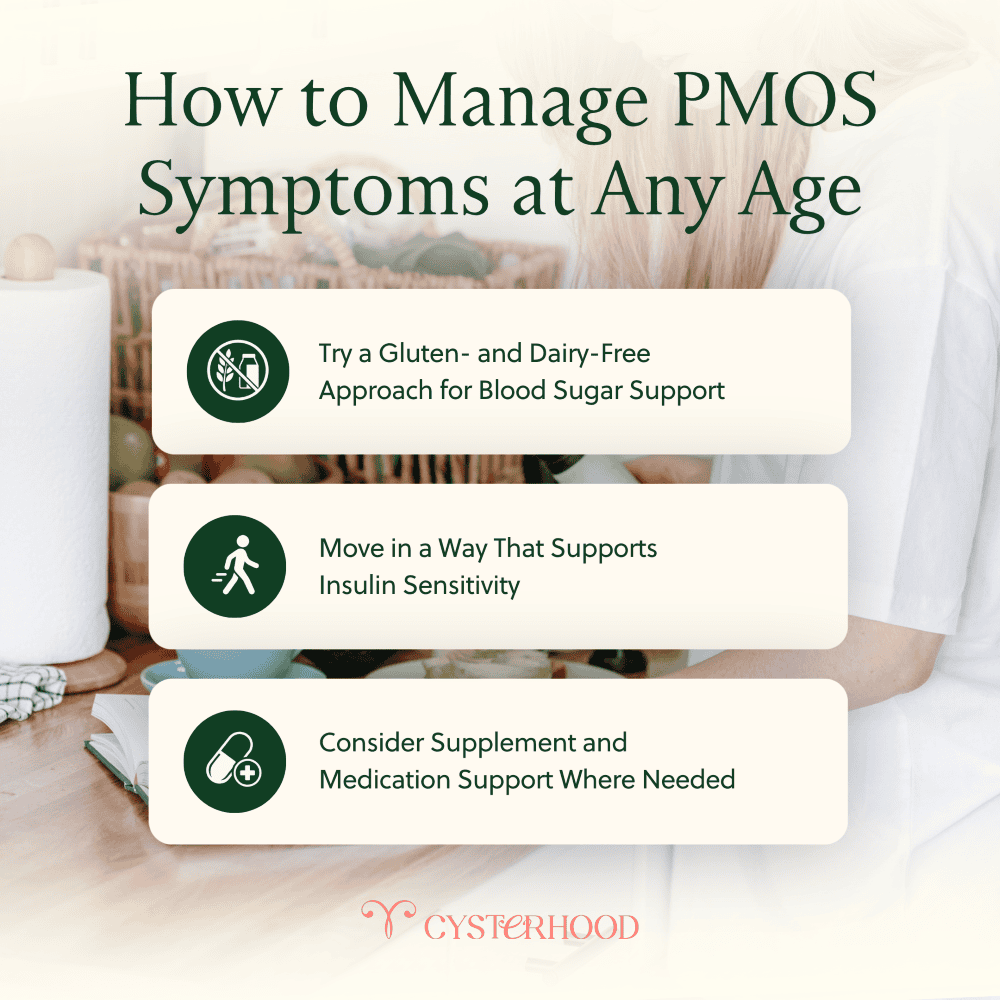
How to Manage PMOS Symptoms at Any Age
Here’s the hopeful part, and I mean it as someone who was handed a diagnosis at 18 and had to learn how to manage my own symptoms. You can support your hormones and metabolism at any age, yes, you read that right, and you don’t have to overhaul your entire life to get started.
These are the habits I come back to, both personally and as a Registered Dietitian supporting other women with PMOS:
Try a Gluten- and Dairy-Free Approach for Blood Sugar Support
Because insulin resistance is so common with PMOS, what you eat matters a lot. And no, I’ll never tell you to restrict your diet or count calories. That’s never been part of my strategy! Instead, I will tell you how important it can be to build meals around protein, fiber, and healthy fats to help steady your blood sugar levels.
I built my whole method around a gluten- and dairy-free approach, because for many of us, those foods drive inflammation. And if you feel like you have no idea where to start, download the Cysterhood App. I’ve created tons of PMOS-friendly meals so you’re not left guessing.
And if you’re not sure whether you’re even dealing with insulin resistance, take my free PMOS quiz to get pointed toward what your body needs first.
Move in a Way That Supports Insulin Sensitivity
Regular movement helps your muscles use glucose, which can support insulin sensitivity over time. But take it from someone who’s been there, done that: you don’t need to overdo it in the gym to get results.
This is exactly why my husband Sirak built the slow-weighted-workout approach in our Cysterhood method. These are gentle strength workouts that don’t spike stress hormones the way cardio can. Consistency matters more than intensity here.
Consider Supplement and Medication Support Where Needed
Some women may benefit from additional support depending on their symptoms and what their doctor recommends. Fortunately, as someone who was also tired of not knowing how to fill nutritional gaps or which supplements to trust, I’ve done the research for you.
Inositol is one supplement that’s been studied for women with PMOS, specifically for metabolic and reproductive outcomes. Berberine is another natural option that’s being studied for metabolic health. While it’s known as “nature’s Ozempic,” I like to think of it as a natural GLP-1 booster, not a one-for-one swap for medication.
If your doctor has prescribed metformin or a GLP-1 medication, always work with them to decide what’s appropriate for you rather than stopping or changing a medicine on your own, especially if fertility or other prescriptions are involved.
This information is educational and not a substitute for medical advice. These statements have not been evaluated by the FDA. OvaFit supplements are not intended to diagnose, treat, cure, or prevent any disease. Always consult your doctor before starting a supplement, especially if you take medication or are pregnant or trying to conceive.
How Late Can PMOS Develop, Realistically?
So, how late can PMOS actually show up? A truly new case starting in your late 40s or after menopause is uncommon. In most cases, PMOS has been there for years, you just haven’t been diagnosed because symptoms either weren’t noticeable or you didn’t know what to look for.
If symptoms are new to you at 38 or 45, it’s still worth investigating. When you figure out what’s happening, you can better support your body and find the PMOS management plan that makes you feel like you again.
This post is for educational purposes only and is not medical advice. Please talk with your doctor or a qualified healthcare provider about diagnosis and any changes to your treatment.
You’ve got this,
Tallene, RD
Feeling lost with PCOS?
Find out your PCOS type and get your next steps in under 2 minutes.
Find My PCOS Type →