

How Many Women Have PMOS? The Real Numbers, Explained

More women are starting to hear the term “PMOS,” which naturally brings up one of the most common questions I get as a registered dietitian specializing in the condition: “Who all actually has PMOS? And is it as common as research makes it seem?”
The answer isn’t as simple as giving you one perfectly round number. We have prevalence estimates for PCOS, now called PMOS, but even those can vary depending on how researchers define the condition and diagnose the condition. There is one thing we do know, though, that an unfortunately large number of women with the condition haven’t even been formally diagnosed with it.
PMOS, which stands for polyendocrine metabolic ovarian syndrome, is the updated name for polycystic ovary syndrome (PCOS). You’ll still see the former name used throughout most of the research and data, a lot of which I’ll be using below.
Whether you’re new to the condition and diving into the content wondering “What Is PMOS?” or you’re a woman who’s been questioning whether she’s had the condition for years and not realized, here’s the truth on how common the condition is:
How Many Women Have PMOS Worldwide?
More than 170 million women worldwide are estimated to have polyendocrine metabolic ovarian syndrome (PMOS), formerly known as PCOS. That’s roughly 1 in 8 women of reproductive age.
The numbers aren’t exactly the same across every source, though. The World Health Organization, for example, estimates that PMOS affects 10-13% of reproductive-aged women worldwide.
Why the difference? Because researchers haven’t always used the same criteria to diagnose PMOS. Change the way a study defines PMOS, and you can end up with a very different number of women being diagnosed. And then we have women who have PMOS but don’t even know it yet.
For now, the important number to remember is that we’re talking about roughly 1 in 8 women. We’ll look at why that estimate has such a wide range below.
What Is PMOS?
PMOS stands for polyendocrine metabolic ovarian syndrome, the new name for polycystic ovary syndrome (PCOS). So if you were originally diagnosed with PCOS, don’t worry, I’m still talking about the very same condition.
The updated name better reflects what we now know about the condition and the different systems it can affect. PCOS has always sounded like the condition starts and ends with the ovaries, but we know that there’s more involved than that. PMOS can affect your hormones, ovulation, and the way your body responds to insulin.
And contrary to the old name, PCOS, you don’t need ovarian cysts to have PMOS. The “cysts” associated with PCOS are actually immature follicles, and not every woman with the condition has polycystic-appearing ovaries on an ultrasound.
That’s part of why the name change to polyendocrine metabolic ovarian syndrome is a much more accurate description. It accounts for the hormonal and metabolic side of the condition, which as women with PMOS know, is a significant part of what we experience day to day.
How Common Is PMOS?
PMOS is one of the most common hormonal conditions affecting women of reproductive age. The World Health Organization estimates that about 10–13% of women in this age group have PMOS, although other research has reported numbers anywhere from about 4–20%.
That’s a pretty big range, but it doesn’t necessarily mean that the research is conflicting. Different studies have looked at different populations and used different criteria to decide who has the condition. And again, we also have the women who haven’t even been diagnosed. Some may have symptoms years before getting a diagnosis, while others may not realize that things like irregular periods, acne, excessive hair growth, or increased cravings could be related.
So when we talk about how common PMOS is, what we’re really looking at is the women that researchers have been able to actually confirm have the condition. There are likely many more women who haven’t even made their way into the data yet.
Why Is It Hard to Pin Down an Exact Number?
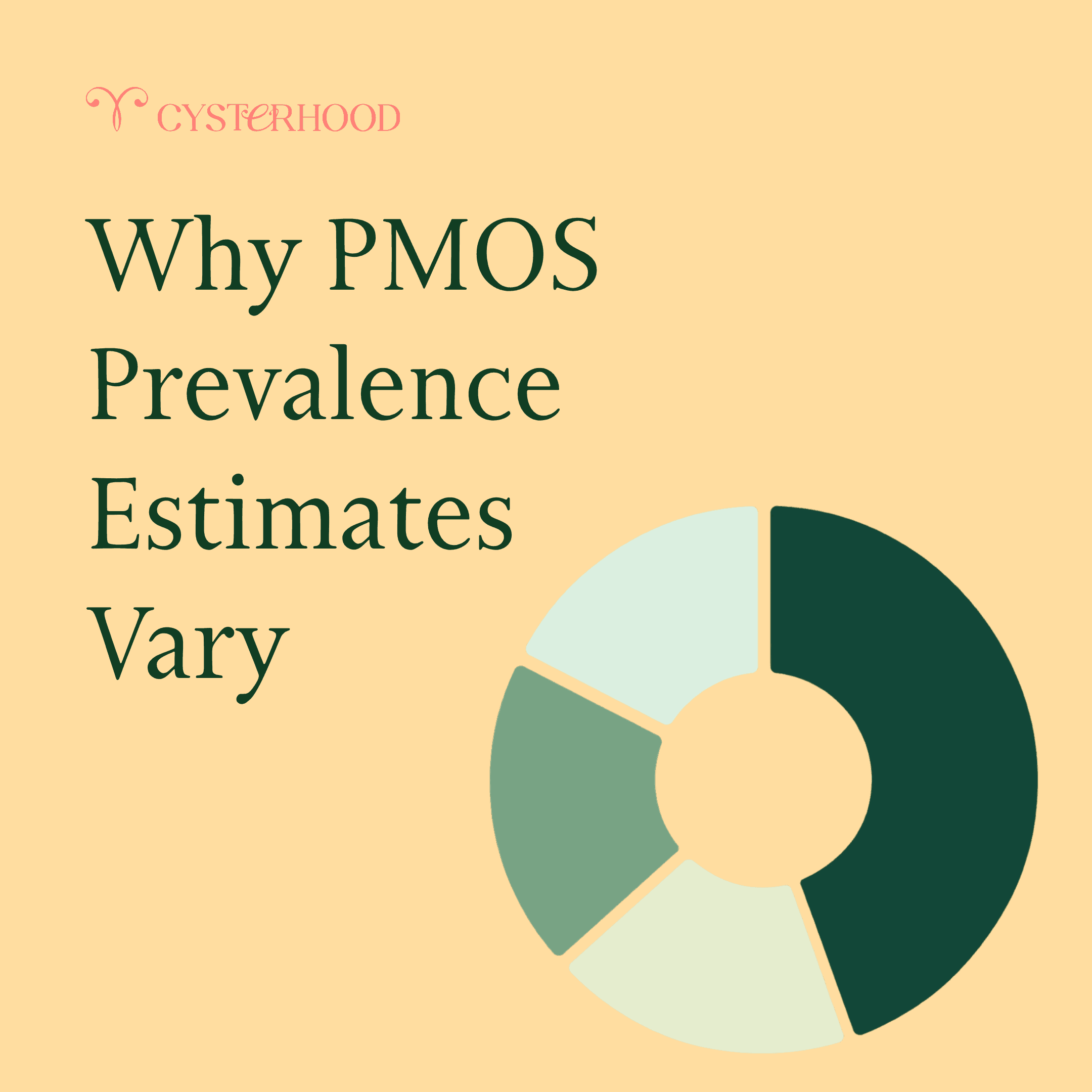
One reason that PMOS prevalence is so hard to find an exact number for is because it hasn’t always been defined the same way. There are several sets of diagnostic criteria that have been used in PMOS research, and they don’t identify exactly the same group of women. The Rotterdam Criteria, for example, are broader than some earlier definitions. That alone can make prevalence look different from one study to another.
You can see how much of a difference this makes by just looking at individual research. In one study, 16.6% of the women met the Rotterdam Criteria. When researchers changed how the ovarian component was assessed, the estimates dropped to 6.3% and 8.5%. That isn’t a small difference.
Where the research takes place matters too. We don’t have equally detailed population data from every country or even every group of women, so there are still pretty large gaps in what we know about worldwide prevalence.
And finally, there’s underdiagnosis, which I’ve already talked about. If a woman has PMOS but hasn’t been diagnosed, she can easily be missed in all of the evidence-backed studies. The recent name change, naturally, adds one more factor to think about. Polyendocrine metabolic ovarian syndrome is still a relatively new term, while decades of research were published under polycystic ovary syndrome.
For now, we have to look at the PCOS research when we want to understand just how common the condition is.
Why Understanding How Common PMOS Is Matters
Understanding the prevalence gives researchers and healthcare providers an idea of how many women are affected by PMOS. And for those of us with the condition, it can also put our own experiences into perspective.
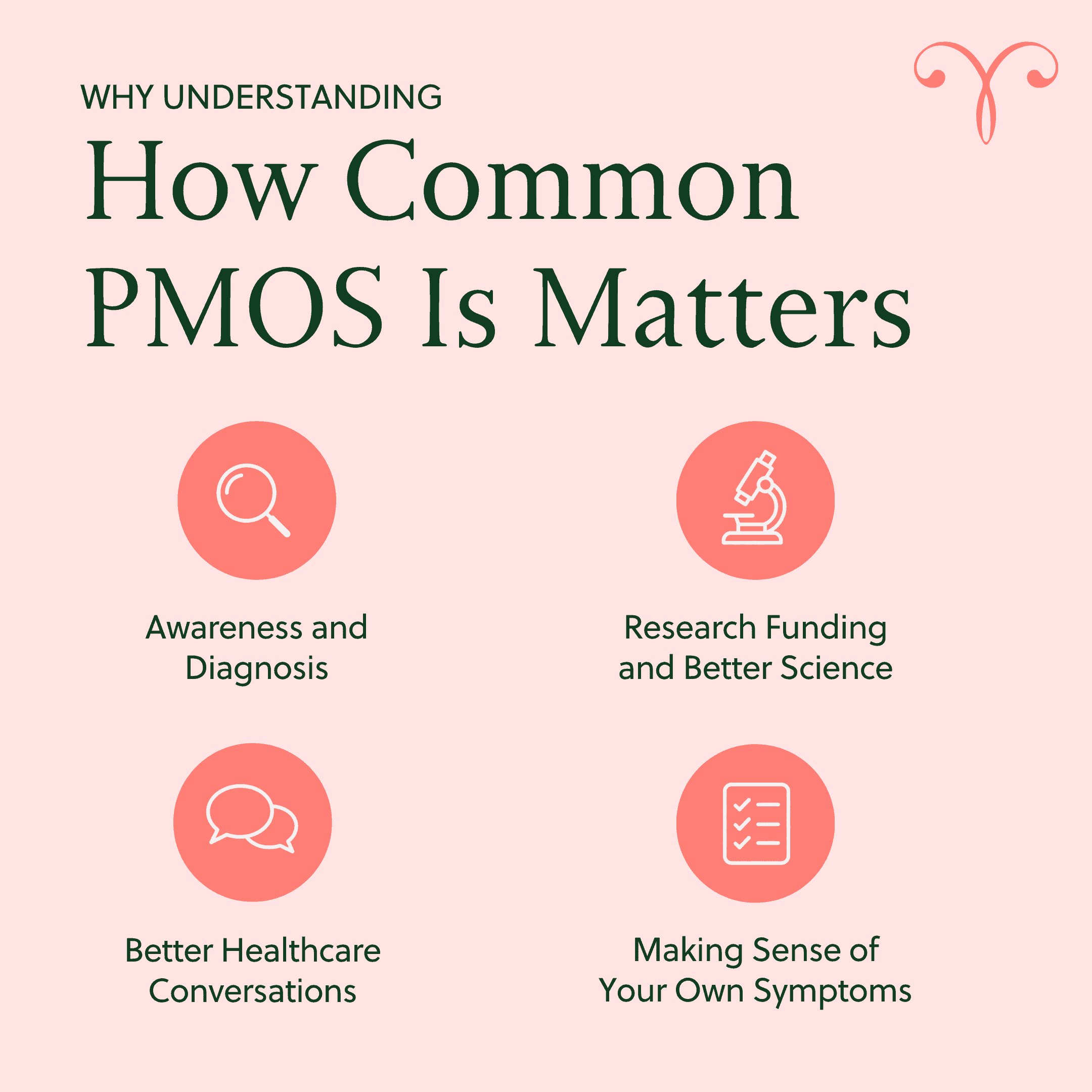
Awareness and Diagnosis
Too many women spend years dealing with PMOS symptoms before they know what’s causing them. Maybe your periods have always been irregular, or maybe you’ve been told to “just lose weight” without getting much advice beyond that. Better awareness of how common PMOS is can help more women recognize when their symptoms are worth bringing up to a healthcare provider. It also gives us another reason to keep talking about a condition that affects millions of women worldwide.
Related: Can You Have Regular Periods And Have PMOS?
Research Funding and Better Science
Knowing how many women have PMOS also helps show the need for continued research long term. There are still SO many questions about why PMOS looks so different from one woman to another and which approaches may be most helpful for different symptoms. Even the different types of PMOS are something researchers are continuing to learn more about. More research gives us better information to use when making decisions about our PMOS management plans, both now and in the future.
Better Healthcare Conversations
You don’t need to be an expert on PMOS before talking to your doctor. But knowing that this is a common hormonal and metabolic condition can make it a little easier to speak up about symptoms you’re concerned about. Ask about the things you’ve noticed. Bring up changes in your period, hair growth, acne, or weight. Talk about what encouraged you to make the appointment in the first place. And if your provider recommends testing, ask what your results mean rather than trying to interpret every number on your own.
Making Sense of Your Own Symptoms
Sometimes the first helpful thing about learning you have PMOS is realizing that symptoms you thought were separate may actually be related. And they may actually mean something beyond the usual “I’m just tired,” “It’s that time of the month,” and “It’s probably just because I’m stressed.”
Not every woman with PMOS will have the same symptoms, which is why your experience may look completely different from someone else’s. Knowing how common PMOS is doesn’t tell you exactly what’s happening in your body, but it does show you just how many women are right alongside you, dealing with some version of what you feel so alone in right now.
Understanding Your PMOS and What Comes Next
Whatever the exact worldwide figure turns out to be, here’s what I want you to take from it: millions of women are managing PMOS, and there’s a way to work with your body instead of against it.
The path I come back to with the women I work with is a gluten- and dairy-free approach, low-impact movement, stress management, quality sleep, and, if necessary, supplements designed for women with PMOS. You can live symptom free, and PMOS doesn’t have to be the hold making the shots anymore.
Not sure where you land in this conversation? Take our free PMOS quiz to get a read on your symptoms and a starting point that fits you. When you’re ready to put this into practice, download The Cysterhood App for PMOS-friendly meals, slow-weighted workouts, and a community of women doing this together. It’s the day-to-day system built to help you manage PMOS with consistency over time.
You’ve got this,
Tallene, RD
Medical disclaimer: This article is for educational purposes only and is not a substitute for professional medical advice, diagnosis, or treatment. PMOS involves your hormones and metabolism, so please talk to your doctor before making changes, especially anything touching medications, fertility, or a diagnosis. Always seek the guidance of your physician or qualified health provider with any questions about your health.
Feeling lost with PCOS?
Find out your PCOS type and get your next steps in under 2 minutes.
Find My PCOS Type →