
Is It PMOS (PCOS) or Perimenopause? How To Tell the Difference

I was diagnosed with what was known at the time as polycystic ovary syndrome (PCOS) when I was 18, after a ruptured ovarian cyst. I was told I had a hormonal syndrome that affects my menstrual cycle, and I was handed the same “just lose weight” advice so many of you have gotten. That’s pretty much the extent of the education I received at the time, and it’s what many women with PCOS are still being told today.
There was a recent change in the name PCOS which better encompasses the complexity of the condition. The new name is (PMOS) polyendocrine metabolic ovarian syndrome. This name more effectively captures the impact this condition has on our bodies beyond the reproductive system.
In my work with women with PMOS, I’m noticing more and more women in their 30s and 40s starting to deal with perimenopause, and many of them ask me the same thing: “Is this my PMOS, perimenopause, or both?” It’s often difficult to tell, since both can bring irregular cycles, weight gain, mood changes, and shifting hormones, and symptoms alone usually can’t answer that question. Unfortunately, I also see women whose PMOS gets missed (or brushed aside), or whose perimenopause gets missed.
So in this article, I’ll cover:
- The symptoms PMOS and perimenopause share, and the key differences in menstrual changes, hormone patterns, and metabolic health
- Signs that may indicate you have PMOS, perimenopause, or both
- What perimenopause can look like when you already have PMOS, including the increased health risks
- What to discuss with your healthcare team, and when you should think about seeing your provider
Is It PMOS (PCOS) or Perimenopause? The Honest Answer
Can you tell from your symptoms alone whether it’s perimenopause or PMOS? Not really, since both have very similar symptoms.
PMOS is a hormonal and metabolic syndrome that usually shows up during a woman’s reproductive years (think teens or 20s), and it’s a condition you have for your whole life.
Perimenopause, on the other hand, is the change a woman’s body and menstrual cycle go through leading up to menopause. It’s a normal part of aging, and it involves changes in hormones and menstrual cycles. For many women, this change starts around age 45, but for some it can start in the late 30s.
Can you have both at the same time? Yes. Age, symptoms, menstrual history, medical history, and testing all come into play when your healthcare provider tries to figure out what’s happening in your body.
Unfortunately, what often happens is this; A woman in her early to mid-40s notices her periods becoming more irregular, along with some mood and anxiety symptoms and some weight gain or fluctuations. If her doctor knows she has a PMOS diagnosis, they may chalk all of it up to that. On the flip side, if the same woman goes in without a previous PMOS diagnosis, her provider may chalk it up to perimenopause starting a little early.
It’s rare to see providers look at and discuss both. That’s why it’s important to have an open dialogue with your healthcare provider and advocate for yourself. It’s okay to ask questions, push back a bit if they brush you off with comments like “just lose weight,” and get a second opinion if you aren’t feeling heard.
What Symptoms Are Similar Between PMOS (PCOS) and Perimenopause?
Both conditions share a lot of the same symptoms, including:
- Changes in your period (irregular, delayed, or skipped periods, or changes in your flow)
- Weight changes or weight gain, often around the midsection
- Irritability, mood changes, and anxiety, which show up in both
- Trouble sleeping, whether that’s falling asleep or staying asleep
- Hair thinning on the scalp, which can appear with either
- Breakouts (acne), which can flare in both
- Fatigue, which is common in both
- Changes in the way your body handles blood sugar (a risk factor to keep an eye on for your long-term health with both conditions)
Key Differences Between PMOS (PCOS) and Perimenopause
Unfortunately, there’s no clear-cut medical test that separates perimenopause symptoms from PMOS symptoms. That’s why a full medical assessment is important. There’s some crossover between the symptoms and signs, but there are also some key differences.
When Symptoms Started
Symptoms of PMOS typically start in a woman’s teens or 20s, while perimenopause symptoms typically start in her late 30s or 40s (although there’s a range with both conditions).
Menstrual Cycle Patterns
With PMOS, periods may be irregular, far apart, or absent (amenorrhea) for most of a woman’s reproductive years. Perimenopause is the transition from when a woman’s menstrual cycles start to change to menopause (the permanent absence of periods), and estrogen decreases during this time.
So a long history of irregularity leans toward PMOS, while cycles that used to be regular and are now changing lean toward perimenopause.
Hormone Patterns
Perimenopause is characterized by fluctuating levels of estrogen and progesterone. PMOS is characterized by high androgen levels (androgens are often called male hormones) and may also involve high estrogen. Those higher androgen levels are behind classic PMOS symptoms like unwanted hair growth and facial acne.
Hot Flashes and Night Sweats
Hot flashes and night sweats can be common with perimenopause, but they aren’t typically a symptom of PMOS on its own. Hot flashes and night sweats are classic menopause symptoms, so if they’re new for you, that’s worth noting.
Weight and Metabolic Changes
Weight and metabolic changes can happen in perimenopause because of muscle loss and shifts in body fat, and also because falling estrogen takes away some of your metabolic “protection.” With PMOS, insulin resistance at the cellular level is often the driver behind PMOS symptoms and stubborn weight.
Quick Comparison Table
| Feature | PMOS (PCOS) | Perimenopause |
| Typical Age of Onset | Often diagnosed in teens or 20s; symptoms may be present since the first period | Late 30s to 40s (average mid 40s), leading up to menopause |
| Primary Hormonal Driver | Chronic hormonal imbalance and high androgens, with or without insulin resistance | Declining and fluctuating estrogen and progesterone |
| Menstrual Pattern | Often consistently irregular cycles since early reproductive years | Cycles were typically regular first, becoming irregular now |
| Acne and Hirsutism (Excess Hair Growth) | Common, especially if androgen dominant | Not typical unless underlying PMOS or androgen excess is still active |
| Hot Flashes and Night Sweats | Not typical | Very common |
| Bloating | Common (especially around ovulation or the luteal phase | Common (can worsen with low progesterone) |
| Mood changes | Common; may be linked to ovulation or hormone phase | Common; can be intense due to hormone swings |
| Fatigue | Common | Common, often made worse by sleep disruption |
| Libido Changes | Variable; may be low, high, or inconsistent | Often fluctuates; can rise early, then decline later |
| Breast Tenderness | Not a hallmark symptom | Common, especially with estrogen surges early in perimenopause |
What Does Perimenopause Look Like With PMOS (PCOS)?
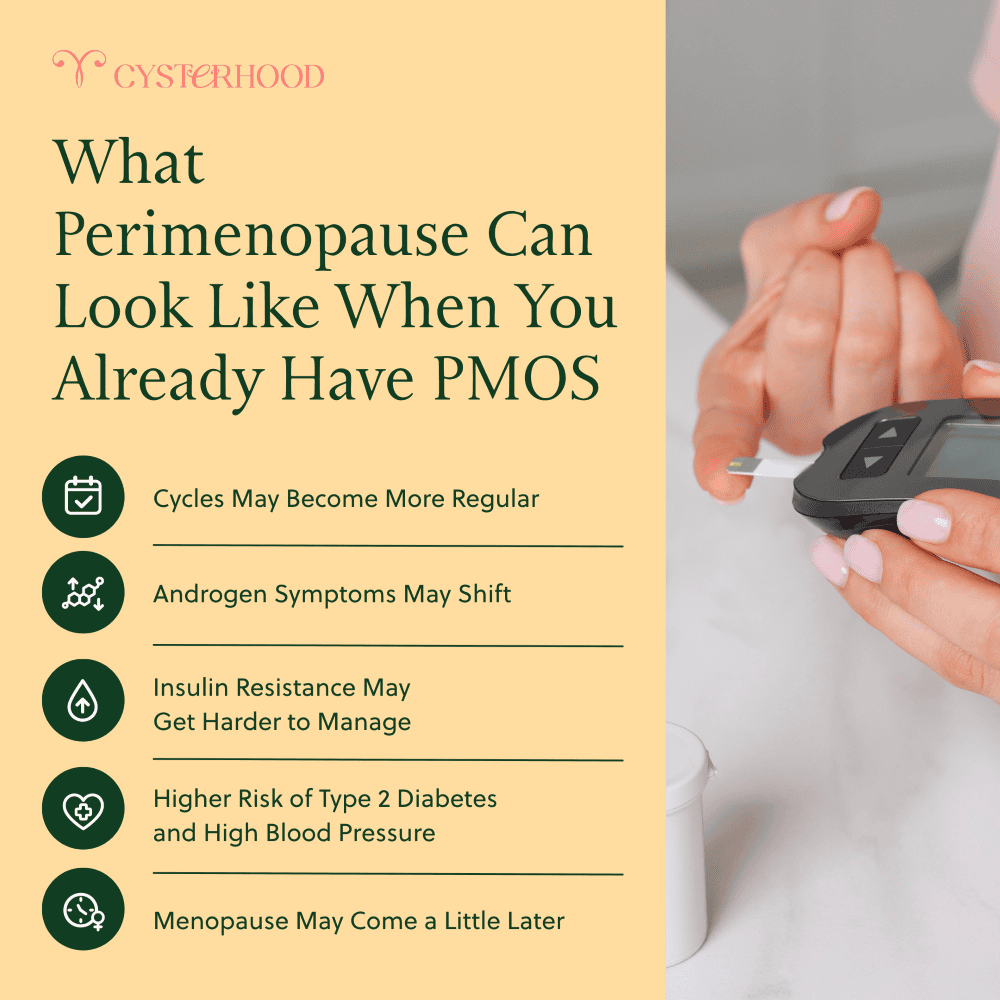
When you enter perimenopause with PMOS, the two don’t necessarily cancel each other out. In fact, symptoms may be more intense with perimenopause and PMOS together, which makes it even harder to tell what’s coming from what. At the same time, some PMOS symptoms may actually ease.
Cycles May Become More Regular
Testosterone production from the ovaries and adrenal glands naturally starts to decrease in our 30s. So some women with PMOS find their menstrual cycles are actually more regular during perimenopause, and they may even ovulate.
Androgen Symptoms May Shift
If you’ve dealt with high testosterone from PMOS in the past, symptoms such as facial hair growth, thinning scalp hair, and hormonal acne may subside during perimenopause.
Insulin Resistance May Get Harder To Manage
In my work with women going through this transition, the pattern I see most often is the metabolic side demanding more attention right when the reproductive symptoms start to quiet down. So I’d still pay attention to metabolic health. During perimenopause, estrogen decreases, which can make insulin resistance harder to manage.
Higher Risk of Type 2 Diabetes and High Blood Pressure
Women with PMOS are already at higher risk for type 2 diabetes, high blood pressure, and more. During the reproductive years, women with PMOS are more likely to develop obesity, dyslipidemia, type 2 diabetes, impaired glucose tolerance, and metabolic syndrome.
This is why long-term health screening matters so much in this stage. I’d continue to pay attention to symptoms, food, lifestyle, and lab work.
Menopause May Come a Little Later
Research suggests that menopause may be delayed in women with PMOS. A large 2026 Finnish birth cohort study found that being late peri- or postmenopausal, or having menopausal symptoms, was less common in women with PMOS at age 46, suggesting longer-lasting ovarian activity and a delayed menopausal transition. Past studies have found that women with PMOS may reach menopause 1 to 3 years later than women who don’t have PMOS.
I’ve also written an article on some of the research around the question: does PCOS cause early menopause?
If you’d like some support figuring out which symptoms to bring up with your doctor, take our free PMOS quiz.
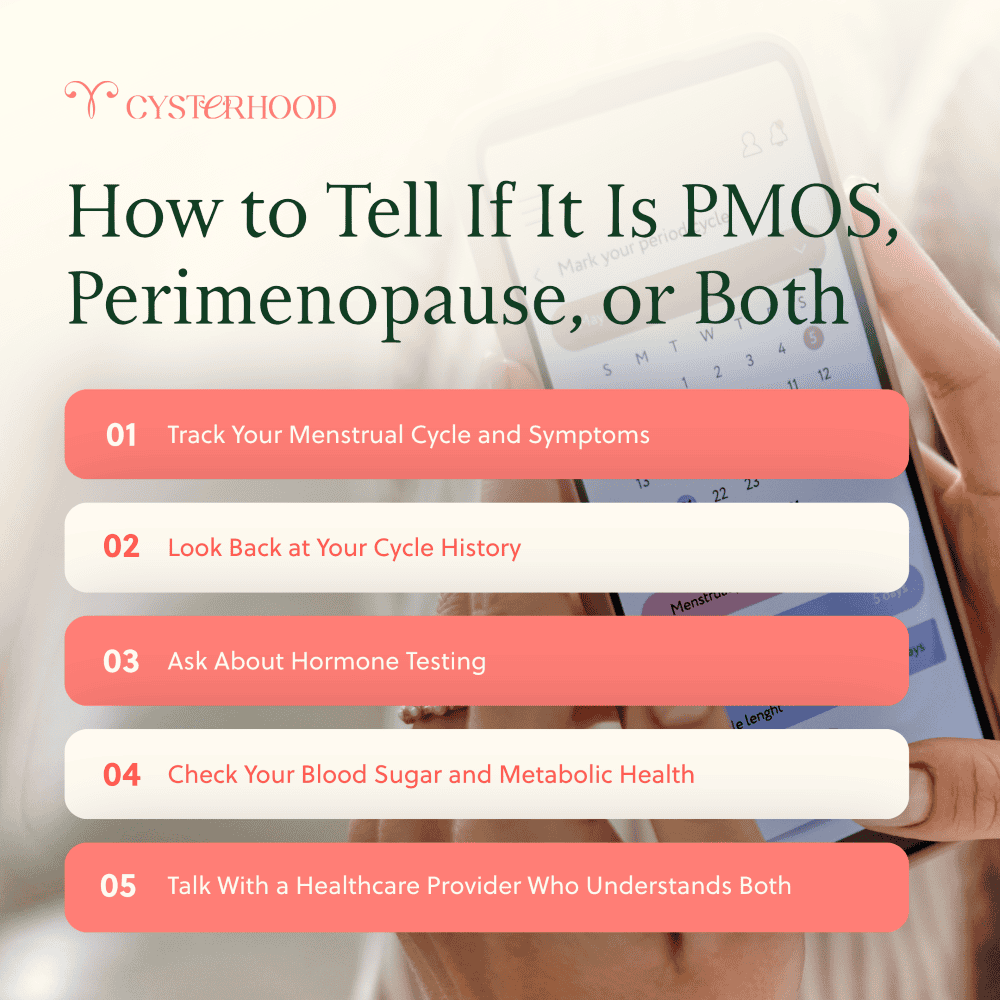
How To Tell if It Is PMOS (PCOS) or Perimenopause
Unfortunately, there’s no way to determine on your own whether this is PMOS or perimenopause. But there are some things you can do to get a better understanding and have a more productive conversation with your healthcare provider.
Track Your Menstrual Cycle and Symptoms for a Few Months
If you’re still menstruating, I highly recommend tracking your menstrual cycle. Note:
- Length of your cycle (the number of days from the first day of your period to the first day of your next one)
- How heavy or light the flow is
- Other symptoms (hot flashes, mood, energy, sleep, etc.)
This can be hard to decipher in perimenopause, but gathering as much info as possible is helpful to bring to your healthcare provider. Patterns may become clearer after a few months of tracking. If you know your body well and these changes aren’t typical for you, that’s useful information too.
Look Back at Your Cycle History
- Has your menstrual cycle always been irregular (going back to your teens)? This may be a sign of PMOS.
- Has your menstrual cycle typically been regular but recently started to become irregular? This may be a sign of perimenopause.
Ask About Hormone Testing
FSH (follicle-stimulating hormone) levels increase in perimenopause and menopause, so your healthcare provider may check this to see where you are with perimenopause. That said, if you’re over 45, chances are you don’t need to be tested, because higher FSH levels are expected with perimenopause and menopause. A one-time measurement also may not tell the whole story, since hormone levels in perimenopause can go up and down dramatically from one day to the next.
Check Your Blood Sugar and Metabolic Health
During perimenopause, it’s extra important to pay close attention to things like your blood sugar and blood pressure. Get an idea of where these numbers are right now, since this information is helpful for both PMOS and perimenopause.
Talk With a Healthcare Provider Who Understands Both
Bring all of this information to your healthcare provider. Let them know what symptoms you’re having, show them your menstrual tracking, talk about your past menstrual history and PMOS diagnosis, and share the results of any lab work (hormones, blood sugar, etc.).
Ask if they think it may be perimenopause, PMOS, or both, whether they’ve seen this before, and what other testing can help figure out what’s causing your symptoms. Basically, ask them whether they’re considering both PMOS and perimenopause rather than brushing one off.
If you’re still sorting out whether you have the condition at all, my guide on how to know if you have PCOS is a good next read.
When To Get Checked Out
See a healthcare provider soon if:
- Your menstrual bleeding is very heavy
- You bleed between periods
- You bleed after menopause (after going a full year without a period)
This post can help give you a better idea of what might be happening and which questions to discuss with your healthcare provider, but it isn’t medical advice. If you have questions or concerns about your symptoms, hormones, medications, or diagnosis, please talk with a qualified medical provider.
How To Support Your Body Through PMOS (PCOS) and Perimenopause
You can support your body, your hormones, and your metabolism at any age, and this stage is no exception. Here’s where I’d put your energy.
- Balance your blood sugar with food. Adding protein and fiber can help support insulin sensitivity, especially during times of hormonal change like falling estrogen. Rather than oatmeal for breakfast, how about some eggs and an avocado?
- Try a gluten- and dairy-free diet. I always recommend this because for some women with PMOS, gluten and dairy may worsen symptoms and inflammation. It isn’t a guaranteed fix, but you might just see it help.
- Keep up with strength training. This becomes even more important in perimenopause as we start to lose more muscle, and strength training helps with that and supports insulin sensitivity. I lean toward low-impact, slow-weighted workouts that generally don’t spike cortisol the way intense exercise can.
- Prioritize sleep. Poor sleep nudges blood sugar and hormones in the wrong direction, so protecting it pays off.
- Manage stress. Chronic stress raises cortisol, which can work against your blood sugar goals.
- Focus on a healthy weight for the long haul. Aim for a healthy weight over time rather than fast weight loss. Sustainable weight loss supports your metabolism far better than crash efforts.
- Ask your provider about hormone replacement therapy. For some women, hormone replacement therapy is a good fit for menopause symptoms, and it’s worth an honest conversation with your doctor.
My Top Recommendation for Women in This Stage
My top recommendation for women in this stage is simple: don’t go it alone, and get specific. Vague advice is what failed you before.
Not sure where you land? Take our free PMOS quiz to get a clearer sense of what your symptoms are pointing to. And when you’re ready for day-to-day structure, you can download The Cysterhood App for PMOS-friendly meals, slow-weighted workouts, and a community of women who get it.
Your body works differently, and once you understand how, you can work with it. Whether your symptoms are PMOS, perimenopause, or both, you deserve real answers and a real plan. If you want help building one, take the PMOS quiz or download The Cysterhood App and let’s get started.
You’ve got this,
Tallene, RD
This article is for educational purposes only and is not a substitute for medical advice, diagnosis, or treatment. Always talk with your doctor or qualified healthcare provider about your symptoms, medications, and any questions about your health. These statements have not been evaluated by the Food and Drug Administration.
Feeling lost with PCOS?
Find out your PCOS type and get your next steps in under 2 minutes.
Find My PCOS Type →