

Where Does PMOS Hair Grow? A Dietitian’s Guide to Hair Changes
Hi, I’m Tallene. I’m a Registered Dietitian who specializes in polycystic ovary syndrome (PCOS), now called polyendocrine metabolic ovarian syndrome (PMOS), and who also lives with PMOS.
One of the questions I get asked a lot by women I work with is “where does PMOS hair grow?”
Coarse hair growth on the face and body is one of the more common symptoms of PMOS that women notice and can be distressing for many.
The places unwanted hair may grow vary greatly between women. Some women may only notice a few coarse facial hairs, while other women may notice unwanted hair growth in multiple places. These hair growth patterns are tied to androgenic hormone activity and how your hair follicles respond to it.
Where Does PMOS Hair Grow on the Face and Body?
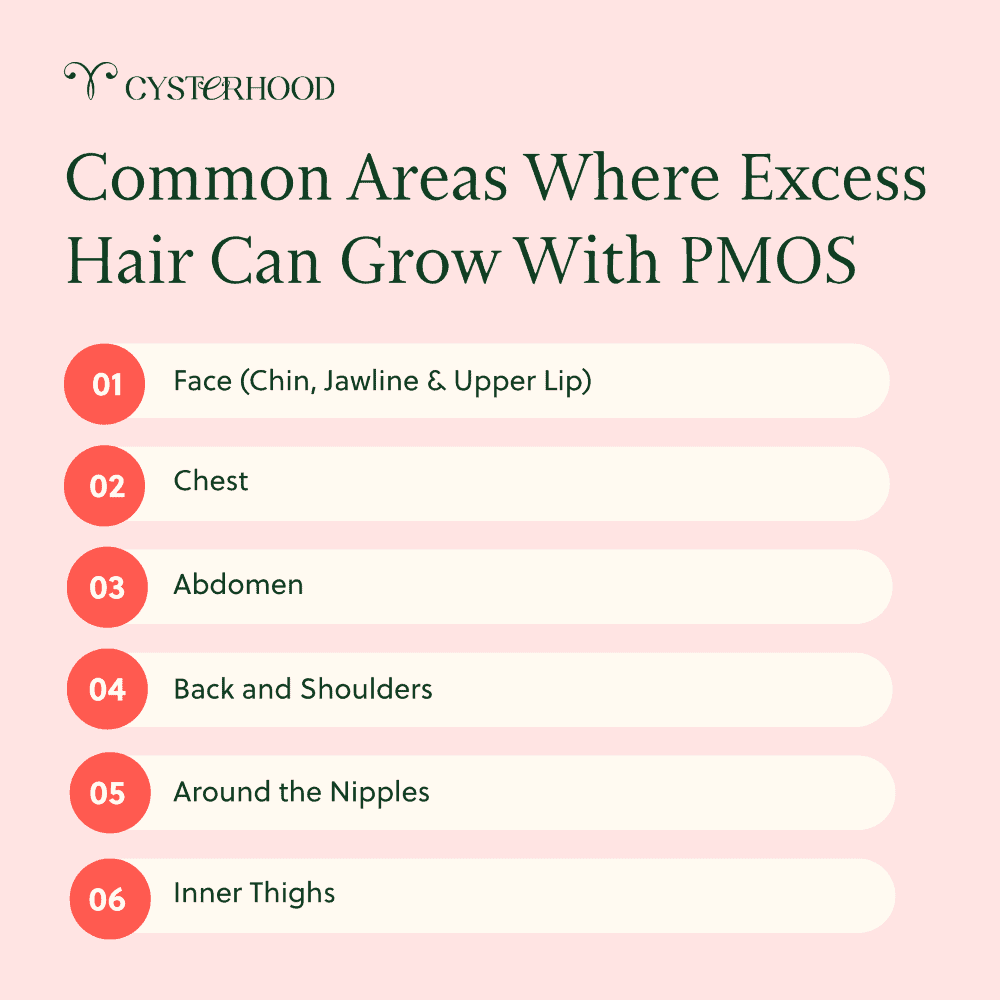
In general, excess hair tends to grow in places where you wouldn’t normally expect it. Common places where unwanted hair growth can occur include:
- Face (e.g., chin, jawline, upper lip)
- Chest
- Abdomen (e.g., a line of hair down from the belly button)
- Back
- Inner thighs
Everyone’s hair growth can be in different places and look different. Yours may look nothing like your sister’s or bestie’s!
Note: this blog post is specifically talking about hair growth on the face and body. PMOS can also impact the hair on our heads. This can present as hair thinning or loss, and sometimes even pattern hair loss.
PMOS-related hair thinning or loss on the head has a slightly different mechanism from hair growth on the face and body, and is covered in my post, how to reverse PCOS hair loss naturally.
Why Does PMOS Cause Excess Hair Growth?
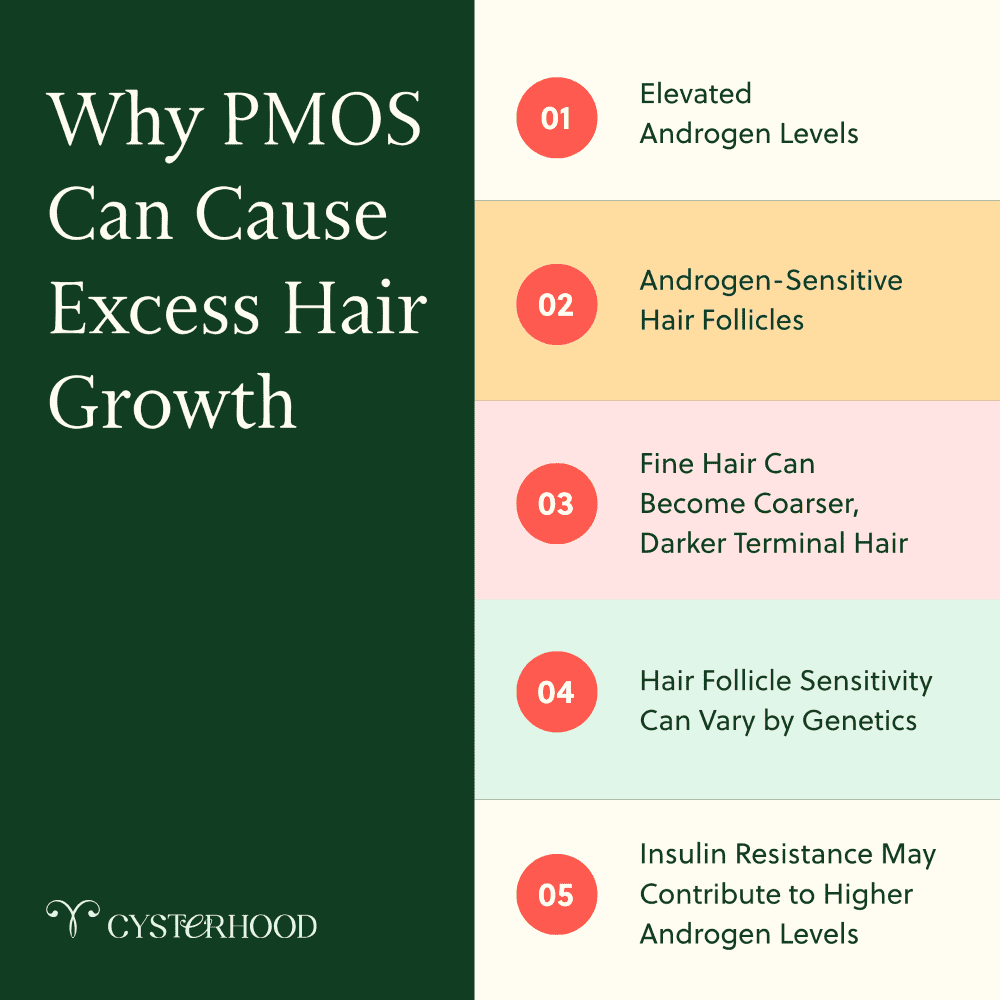
Excess hair on the face and body occurs as a result of changes in communication between androgenic hormones and our hair follicles.
When androgenic hormone levels increase, androgen-sensitive hair follicles produce coarser, darker hair.
Elevated Levels of Androgens and Hair Follicles
Androgens are hormones (e.g., testosterone). Everyone has androgens, with women generally having them in smaller quantities than men.
Some women with PMOS have elevated levels of androgens. This can occur as a result of insulin resistance, where increased insulin levels can stimulate the ovaries to produce more androgens. Higher androgens can also increase oil production in your skin, which is why acne often shows up alongside excess hair.
Normal Body Hair vs. Terminal Hair
Most of your body is covered in fine hair you barely notice. Under the influence of high androgen levels, fine body hair can convert to what’s known as terminal hair. Terminal hair is coarser, darker, and longer, much like the hair on your head or eyebrows.
This is why excess hair on the face and body can be quite noticeable. Once a fine hair has changed to a terminal hair, it usually doesn’t change back. Supporting your hormones mainly helps with new growth, so hairs that are already there often need hair removal, like laser or electrolysis.
How Hormonal Imbalances Affect People Differently
Even among people with PMOS who have similar hormone levels, hair growth can still look and behave differently. This comes down to how sensitive hair follicles are to androgens, which has a genetic component.
Other factors that can influence hair growth include ethnic background, family history and hormone levels. Some women even have normal androgen levels but hair follicles that are extra sensitive to them. And while how much hair grows can differ by ethnic background, excess hair growth itself appears about as common across ethnic groups.
Where Can Excess Hair Grow With PMOS?
The below are common places excess hair can grow with PMOS. The location and amount of hair depend on your individual biology and hormone levels.
Face
Coarse hair on the face is often one of the first changes women with PMOS notice. Places it commonly grows include the jawline, upper lip and chin, where coarser hairs stand out against finer facial hair. Some women only notice a few coarse facial hairs, while other women experience more widespread excess facial hair.
Chest and Abdomen
Coarse hair can develop on the chest or abdomen (often in a line from the belly button downwards). Changes in hormones can stimulate hair growth in these areas.
Back and Shoulders
Excess hair can also grow on the shoulders and upper back. Hair growth here is less common compared to the face, but it can occur as a result of hair follicles being particularly sensitive to circulating androgens.
Other Areas
Excessive hair growth can also occur on the lower abdomen, around the nipples and on the inner thighs.
When Should You Talk to a Healthcare Professional About Hair Growth?
Excess hair can develop and change gradually with PMOS. That said, there are some situations where it’s advisable to speak to a healthcare professional about it. Talk to your doctor to get an individualized evaluation rather than assuming a diagnosis on your own.
You don’t have to wait until it feels severe to bring it up. The international PCOS guideline asks doctors to treat any report of unwanted hair growth as important, whatever it looks like.
New or Sudden Changes
If you’re developing new hair growth or sudden changes in it (i.e., hair is appearing or increasing over weeks instead of months), speak to your doctor or OB-GYN. This could indicate changes in your hormones which would be worth investigating further. On rare occasions, hair that appears suddenly and progresses quickly comes from a cause other than PMOS, such as an androgen-producing tumor in the ovaries or adrenal glands, so your doctor may want to rule that out.
Hair Changes Alongside Other Symptoms
Excess hair growth rarely occurs on its own in women with PMOS, and often other symptoms, for example; irregular menstrual cycles, weight gain, acne and androgenic alopecia (pattern hair loss on the scalp), occur. If you’re experiencing more than one of these symptoms, then it’s advisable to seek further investigation. Curious which PMOS type your symptoms point to? Take our PMOS quiz.
Changes That Affect You Day to Day
Unwanted hair growth can be emotionally draining. Whether you want to explore hair removal or cosmetic procedures, or investigate the hormonal cause further, you deserve support! Check out my full PCOS skincare routine and my guide on how to stop facial hair growth due to PCOS for more information on this.
Speak to your medical professional if you’re also experiencing other symptoms, e.g., high blood pressure or very irregular or absent periods, and bring the whole list to your appointment so nothing gets missed.
Supporting Your Hormones With a Gluten- and Dairy-Free Approach
Excess hair can be indicative of hormonal imbalances in women with PMOS, e.g., increased androgens or insulin resistance. As such, strategies to support your hormones can also help.
I advocate for a gluten- and dairy-free approach for women with PMOS. That said, I appreciate not everyone with PMOS needs to avoid gluten and dairy, although some women find their symptoms ease when gluten or dairy are minimized or eliminated.
A gluten- and dairy-free approach can help support more favorable insulin levels, which in turn can support favorable androgen levels long term. Although this may not directly tackle excess hair, it addresses a potential root cause.
In terms of exercise, I advocate for low-impact, slow-weighted approaches, as vigorous exercise can raise cortisol, which is less than favorable for women with PMOS.
Want a personalized gluten- and dairy-free approach with PMOS-friendly recipes and workouts? Download The Cysterhood App. Here you’ll find recipes and workouts designed for women with PMOS, as well as access to our private community of like-minded women.
Not sure where to start? Take our PMOS quiz to find your PMOS type, and we’ll guide you in the right direction!
You’ve got this,
Tallene, RD
Medical disclaimer: This content is for educational purposes only and is not medical advice. It is not intended to diagnose, treat, cure or prevent any conditions. Please speak to your doctor or qualified medical professional before making any changes to your diet, lifestyle or exercise, particularly if you take medications or have been diagnosed with any conditions.
Feeling lost with PCOS?
Find out your PCOS type and get your next steps in under 2 minutes.
Find My PCOS Type →