
Will Insurance Cover Ozempic for PCOS? Costs and Options

One of the biggest challenges women with polycystic ovary syndrome (PCOS) face is weight management. For many, maintaining a stable weight can feel especially difficult due to the condition’s underlying hormonal factors. Inflammation, insulin resistance, and hormonal imbalances can disrupt normal metabolic function, leading to increased appetite, intensified cravings, fatigue, and, ultimately, weight gain.
The more frustrating part? Many women with PCOS are told by doctors that one of their only treatment options is weight loss. But how? If you’re like many Cysters, you feel like you’ve tried everything. Thankfully, there is a way to naturally manage your PCOS symptoms and lose weight. You can learn all about it here on the PCOS Weight Loss blog!
That said, as Ozempic becomes more and more common, Cysters are taking notice. Many are wondering if it could be their ticket to weight loss and symptom relief. It seems simple enough: take a once-weekly injection and watch the pounds melt away. But is it too good to be true? And would insurance even cover it for PCOS?
I’ve got the answers for you. In this post, we’ll break down whether medications like Ozempic are right for PCOS and how insurance coverage works when it’s prescribed off-label. Here’s what you need to know:
Will Insurance Cover Ozempic for PCOS? Costs and Options
When taking unconventional routes to healing, insurance can sometimes be difficult to deal with. Inconsistent processes, confusing policies, and strict approval criteria can leave you feeling frustrated and hopeless.
And many insurance companies view medications like Ozempic and other GLP-1s as non-traditional treatment options. Why? Because it’s only FDA-approved for people with type 2 diabetes, not polycystic ovary syndrome.
However, there are ways to increase your chances of getting Ozempic covered by your insurance provider. It just takes a little strategy, persistence, and understanding of how the system works.
But before you call your insurance company or start diving into deep research, take a step back and consider whether GLP-1 medications are actually right for you. Listen to the episode of A Cyster and Her Mister, “Ozempic for PCOS: Can It Help?” for a helpful starting point as you continue reading.
What Is Ozempic?
Ozempic is a brand name for semaglutide, which is a GLP-1 receptor agonist originally developed to treat type 2 diabetes. Ultimately, this is just a fancy way of saying it mimics your body’s natural GLP-1 hormone.
Ozempic’s hormone manipulation helps regulate blood sugar and appetite in a big way. Specifically, it slows gastric emptying (so you feel full longer), increases insulin release, reduces glucagon levels, and suppresses appetite.
There are lots of semaglutides out there, like Wegovy, which is FDA-approved for weight management. This is important to note because it’s often easier to get insurance to cover Wegovy for PCOS since you’d be using the medication for its intended purpose.
For a deeper dive, read my post “What Is Ozempic?”
How Does Ozempic Help with PCOS?
Ozempic could help with PCOS by reducing insulin resistance, which causes symptoms like weight gain, difficulty losing weight, fatigue, brain fog, skin tags, and more.
However, the potential benefit is only temporary. Without strategic lifestyle changes, you’ll only see results when you’re actively taking the medication and they are intended for life-long use. When you get off, the dysfunction returns, and sometimes it’s even worse than before.
So, before considering Ozempic, read my deep dive: “GLP-1 For PCOS: Is It the Right Choice?” But for now, here’s an overview of some of the pros and cons:
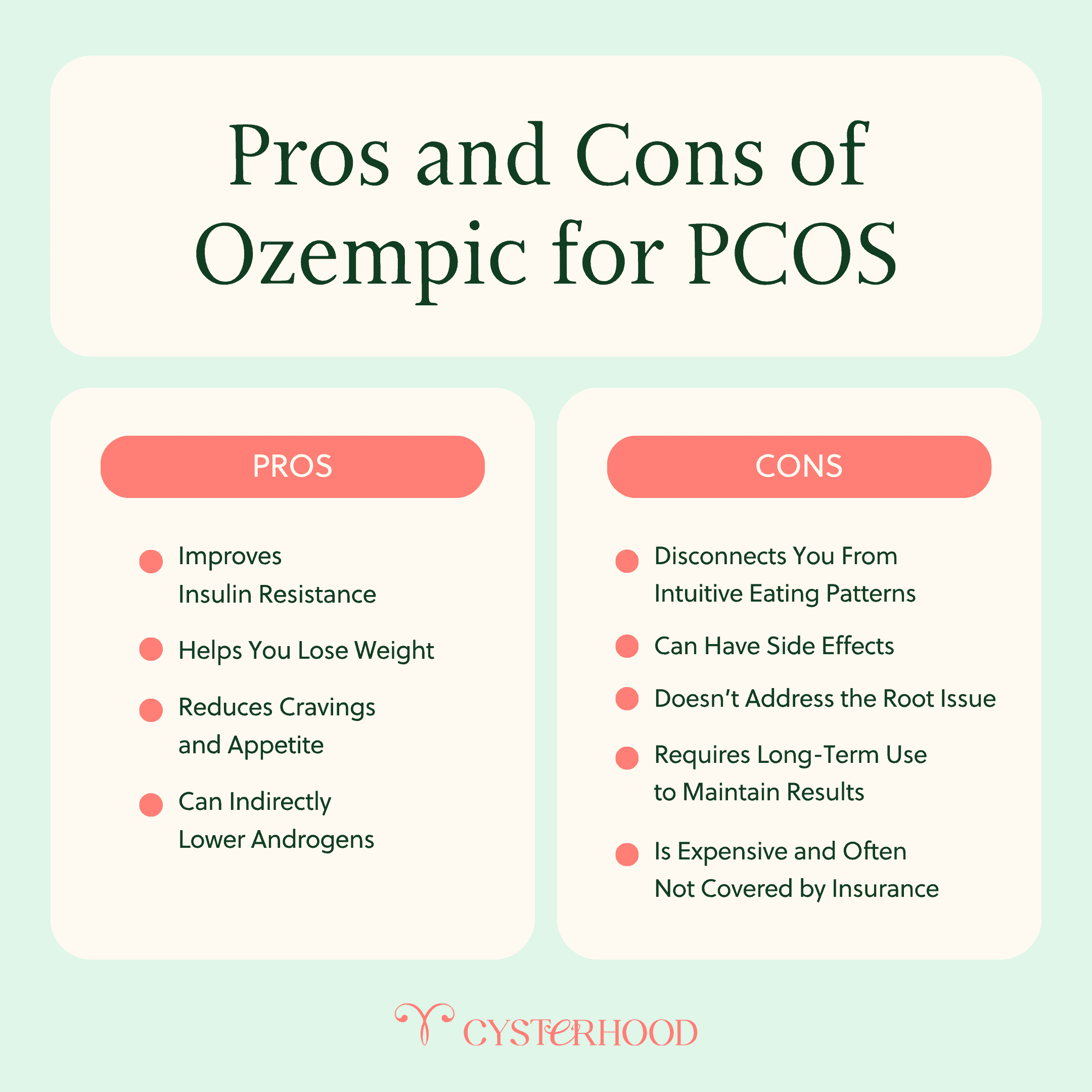
Pros of Ozempic for PCOS
Improves Insulin Resistance
Up to 80% of women with PCOS struggle with insulin resistance, which is when the cells don’t process glucose properly. Instead of using the sugar for energy, it’s stored as fat and absorbed into the bloodstream. This raises blood sugar levels, making it really hard to lose weight and manage metabolic symptoms. Ozempic’s main benefit is that it improves insulin sensitivity, helping you manage your appetite and curb cravings.
Helps You Lose Weight
Since Ozempic has such a huge impact on your metabolism, it can be an effective way to support weight loss. Most people lose 10%-20% of their body weight on Ozempic. For Cysters who struggle with stubborn, insulin-driven weight gain, this can make a big difference in both physical and metabolic symptoms.
Reduces Cravings and Appetite
Ozempic works directly on hunger hormones and brain signals that control appetite, helping you feel full faster and stay satisfied longer. This can significantly reduce cravings! As a result, many women find it easier to eat balanced meals, avoid overeating, and stick with healthy eating habits.
Can Indirectly Lower Androgens
Insulin resistance actually encourages our bodies to produce more androgens. This can lead to symptoms like irregular periods, excessive hair growth on the face and body, acne, and more. So, by improving insulin sensitivity, Ozempic can indirectly help lower androgen levels, leading to healthier menstrual cycles and better hormonal balance.
Cons to Ozempic for PCOS
Disconnects You From Intuitive Eating Patterns
Because Ozempic is so effective at suppressing your appetite, it can be hard to stay in tune with your natural hunger cues. Instead of learning when your body needs more or less fuel, you rely on medication to regulate your intake. This can disconnect you completely from your eating patterns and even cause undereating. As a result, you may not get enough nutrient-dense foods into your diet to support hormones, muscle mass, and overall health.
Can Have Side Effects
Like any medication, Ozempic can come with side effects. The most common side effects of Ozempic are nausea, vomiting, diarrhea, constipation, and fatigue. These are especially prevalent when you first start or are increasing your dose. For some people, these symptoms are mild and temporary. But for others, they can be significant enough to impact daily life.
Could Interfere with Other PCOS Medications and Supplements
Ozempic can interact with other medications and supplements you may be using to manage PCOS, especially those that also impact blood sugar. For example, combining it with options like metformin or berberine may lower blood sugar too much in some cases. This could lead to dizziness, shakiness, or fatigue.
And because it also slows digestion, Ozempic can affect how quickly and effectively your body absorbs other medications, too. This includes thyroid medications, hormonal birth control pills, antibiotics, and more. That’s why it’s important to work closely with your provider and monitor how your body responds when combining treatments.
For more information, talk to your doctor and read these posts next:
- Can You Take Ozempic and Metformin Together?
- Can You Take Ozempic and Berberine Together if You Have PCOS?
Not Safe During Pregnancy or While Trying to Conceive
Ozempic is not considered safe to take during pregnancy. Because of this, most providers recommend stopping it at least a couple of months before trying to conceive. This is important because improving fertility is a common goal for Cysters trying to lose weight. If you’re relying on Ozempic to manage your weight or symptoms, you’ll need a plan to support your body and maintain your results without it during this phase.
Doesn’t Address the Root Issue
Does Ozempic reduce insulin resistance? Yes. It addresses one of the main drivers behind your PCOS symptoms, but does it really fix it? No. GLP-1 medications act like a band-aid, helping manage symptoms while you’re taking them rather than correcting the underlying imbalances driving your condition. Without supportive lifestyle changes, those symptoms often return once you stop the medication.
This is why I am such a big advocate for natural healing. You don’t need to spend the rest of your life masking symptoms when you can actually correct the root issues and reverse your PCOS. So, if you do go on Ozempic, make positive lifestyle changes while you’re taking it. That way, you can establish an exit plan, get off Ozempic, and maintain your results.
Requires Long-Term Use to Maintain Results
Speaking of results, here’s one of the biggest downsides. If you want to keep the weight off that you lost with Ozempic, you’ll likely have to stay on the medication long-term. This may work for some people.
However, relying on a medication indefinitely can come with trade-offs, like ongoing cost, potential side effects, and dependence on something outside your body to regulate appetite and metabolism. It also doesn’t encourage you to build the sustainable habits needed to support your hormones long-term. And, for managing PCOS, long-term hormonal support is key.
Is Expensive and Often Not Covered by Insurance
Let’s not forget: Ozempic is EXPENSIVE. Most insurance policies won’t cover it for PCOS alone, meaning you’ll be paying hundreds for your monthly injections. There is a way to restore your metabolism without Ozempic . . . and it definitely doesn’t cost thousands every year. Keep your money, try to make meaningful lifestyle changes first, and see how your body can heal.
How Much Is Ozempic Without Insurance?
Ozempic costs around $900 to $1,200 per month without insurance, depending on the dosage and pharmacy. Yes, it’s expensive. And since it’s a once-weekly injection, that price only covers about four pens per month. Other options like Wegovy are often just as pricey.
Does Insurance Cover Ozempic for PCOS?
Usually, insurance won’t cover Ozempic for polycystic ovary syndrome alone. Remember, it’s only approved for type 2 diabetes, so you’d be using it “off-label” for PCOS. That can be really difficult to get approved.
This means your doctor has to prove that Ozempic is medically necessary for your specific circumstances. They can sometimes do this if you have other conditions like type 2 diabetes, more significant weight concerns, or other metabolic conditions.
Insurance will often cover more conventional PCOS treatments like hormonal birth control, metformin, and spironolactone. But Ozempic? Don’t count on it.
What Insurance Covers Ozempic for PCOS?
Coverage for Ozempic varies widely by plan, diagnosis, and provider. However, some major insurance companies are known to be more flexible with GLP-1 approvals. Here are some of the best insurance providers for Ozempic:
- Blue Cross Blue Shield
- UnitedHealthcare
- Aetna
- Cigna
- Kaiser Permanente
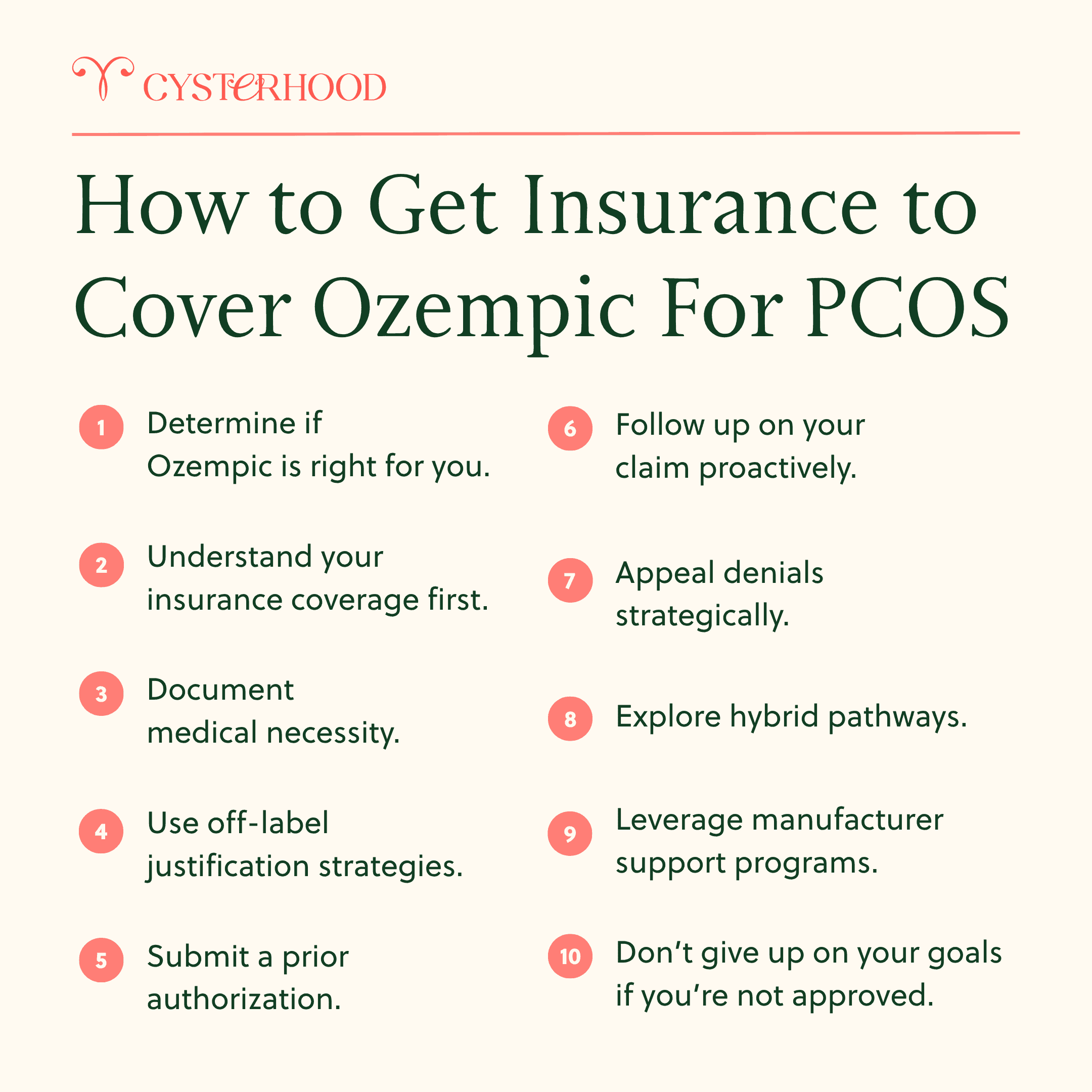
How to Get Insurance to Cover Ozempic for PCOS
Step One: Determine if Ozempic is right for you.
To be honest with you, I don’t usually support the use of Ozempic for PCOS. I completely understand why you’re tempted to try it, though! I was right there with you years ago with unexplained weight gain and a long list of metabolic symptoms.
However, before you start Ozempic, try naturally addressing the root causes of your symptoms. Once you understand what’s actually going on in your body, you can follow my framework to reach your goals naturally—no risky prescriptions required.
Not sure where to start? Here are some ways to manage PCOS symptoms and lose weight. Read that over, and then download The Cysterhood app for more support and essential resources.
Step Two: Understand your insurance coverage first.
If you do think Ozemic is right for you in this season, review your plan details carefully first. Look at things like formulary lists, prior authorization requirements, and any exclusions for weight-loss medications. Knowing what your insurance will (and won’t) consider upfront can save you a lot of time and frustration.
Step Three: Document medical necessity.
Work with your provider to build a strong case that shows why this medication is necessary for you. This might include a history of insulin resistance, failed treatments, or related conditions like type 2 diabetes or prediabetes.
Step Four: Use off-label justification strategies.
Since Ozempic isn’t approved specifically for PCOS, your provider may need to justify its use through related diagnoses. Framing it around metabolic dysfunction, blood sugar issues, or obesity can sometimes improve your chances.
Step Five: Submit a prior authorization.
Most insurance companies require prior authorization for GLP-1 medications. This is where your provider submits documentation explaining why Ozempic is medically necessary and appropriate for your case.
Step Six: Follow up on your claim proactively.
Don’t assume everything is moving along behind the scenes. Call your insurance provider, check the status regularly, and stay in communication with your doctor’s office to avoid delays.
Step Seven: Appeal denials strategically.
If the insurance company denies your request, you still have options. Many approvals happen on appeal, especially when you can provide additional documentation or a stronger justification in round two.
Step Eight: Explore hybrid pathways.
If Ozempic isn’t covered, look into similar medications that your insurance is more likely to approve, like Wegovy for weight management or Metformin for insulin resistance. You can also combine partial insurance coverage with discount programs or pay out-of-pocket short-term while exploring other options.
Step Nine: Leverage manufacturer support programs.
Drug manufacturers sometimes offer savings cards, discounts, or patient assistance programs. These can sometimes significantly reduce your out-of-pocket cost if you qualify, even if insurance doesn’t approve you.
Step Ten: Don’t give up on your goals if you’re not approved.
If you don’t get approved, it doesn’t mean you’re out of options. There are many effective ways to manage PCOS and support weight loss without semaglutides. Don’t give up hope! There’s even a supplement called Berberine that has a similar effect on GLP-1 as Ozempic, but it’s natural, requires no injections, and often has no side effects for women with PCOS.
Most insurance providers won’t cover Ozempic for PCOS.
At the end of the day, getting insurance to cover Ozempic for PCOS will be an uphill battle. If you decide that’s the best route for you, work closely with your doctor, advocate for yourself, and don’t give up.
But remember, medication is just one option. Your body is capable of healing. With the right diet, exercise, and lifestyle changes, you can support your hormones, heal your metabolism, and reach your weight loss goals in a way that actually lasts.
Feeling lost with PCOS?
Find out your PCOS type and get your next steps in under 2 minutes.
Find My PCOS Type →