
Why Is My Menstrual Cycle Getting Longer with PCOS?
The first sign you had polycystic ovary syndrome (PCOS) probably came when you were a teenager. For many of us, that initial clue was irregular periods. While the girls around you had fairly consistent cycles, you were left waiting and wondering when your next period would finally show up.
As you got older, those periods likely stayed irregular. This is especially true if you haven’t yet started managing your PCOS! And for some Cysters, they find their periods becoming more irregular with time, with each cycle getting longer and longer.
If you’re wondering why this is happening and how you can fix it, you’ve come to the right place! In this post, I’ll talk about how PCOS impacts menstrual regularity. Then, I’ll break down the key lifestyle changes that can help get your cycle back on track.
Here’s what you need to know about cycle length and PCOS:
Why Is My Menstrual Cycle Getting Longer with PCOS?
The length of your menstrual cycle is a direct reflection of your body’s hormone balance. So, if you notice more and more time between periods, it’s a sign that something’s off. A healthy period often follows a schedule like:
- Menstruation: 3-7 Days
- Follicular Phase: 10-14 Days
- Ovulation: 1 Day
- Luteal Phase: 12-14 Days
That means the whole cycle should last about 21 to 35 days for women, regardless of their weight, stress levels, diet, or lifestyle habits. However, PCOS can cause intense imbalances of key sex hormones that leave you “stuck” in the follicular phase.
I’ll get into why that happens in a minute. But first, let’s look at what a regular menstrual cycle should look and feel like and how PCOS can negatively affect things like duration, flow, and symptom severity.
How Long Does a Menstrual Cycle Last with PCOS?
Women’s bodies are so different, so one person’s “normal” may be another’s “irregular.” However, it’s important to understand markers that indicate something may be off. Occasional variation can be normal, but consistent lengthening may be a sign that you have unmanaged (or even undiagnosed!) PCOS. Here’s what the average menstrual cycle looks like:
Average Menstrual Cycle
- Cycle length: typically 21 to 35 days
- Ovulation: occurs consistently each cycle
- Period frequency: about once per month
- Bleeding length: 3 to 7 days
- Flow: moderate and predictable (not excessively heavy or very light)
- Symptoms: mild to moderate cramps, manageable PMS
- Pain: minimal to moderate, does not interfere with daily activities
- Pattern: consistent and easy to track
PCOS Menstrual Cycle
- Cycle length: often longer than 35 days or highly irregular
- Ovulation: delayed or absent (anovulation is common)
- Period frequency: infrequent, unpredictable, or missed periods
- Bleeding length: can be very short or prolonged
- Flow: often very heavy with clotting or sometimes unusually light
- Symptoms: more intense PMS, acne, fatigue, mood swings
- Pain: can be more severe, especially with heavy bleeding and inflammation
- Pattern: inconsistent, unpredictable, hard to track
When to See a Doctor About Your Menstrual Cycle
- Cycle length: consistently shorter than 21 days or longer than 35 days
- Ovulation: not ovulating regularly, especially when trying to conceive
- Period frequency: missing periods for 3 months or more (not pregnant)
- Bleeding length: longer than 7 to 8 days
- Flow: extremely heavy (soaking through a pad or tampon every hour)
- Symptoms: persistent signs of hormonal imbalance (acne, excess hair growth, hair thinning), fatigue, dizziness, or weakness
- Pain: severe cramps that interfere with daily life
- Pattern: sudden or unexplained changes in your cycle
Note: Other issues like thyroid conditions, diabetes, and Cushing’s syndrome could cause irregular periods. Make sure you talk to your doctor about your cycle irregularities to ensure you’re dealing with the right diagnosis.
Do Menstrual Cycles Get Longer with Age?
Yes, periods can get longer during perimenopause (late 30s to 40s). During this stage, ovulation becomes less frequent as your body prepares for the end of your reproductive years. You produce less consistent levels of estrogen and progesterone, which can lead to longer, irregular cycles and missed periods.
This goes for every woman, not just someone with PCOS! But, if you’re wondering how your condition impacts this life stage specifically, listen to the episode of A Cyster and Her Mister, “What Every PCOS Woman Should Know About Perimenopause and Menopause.”
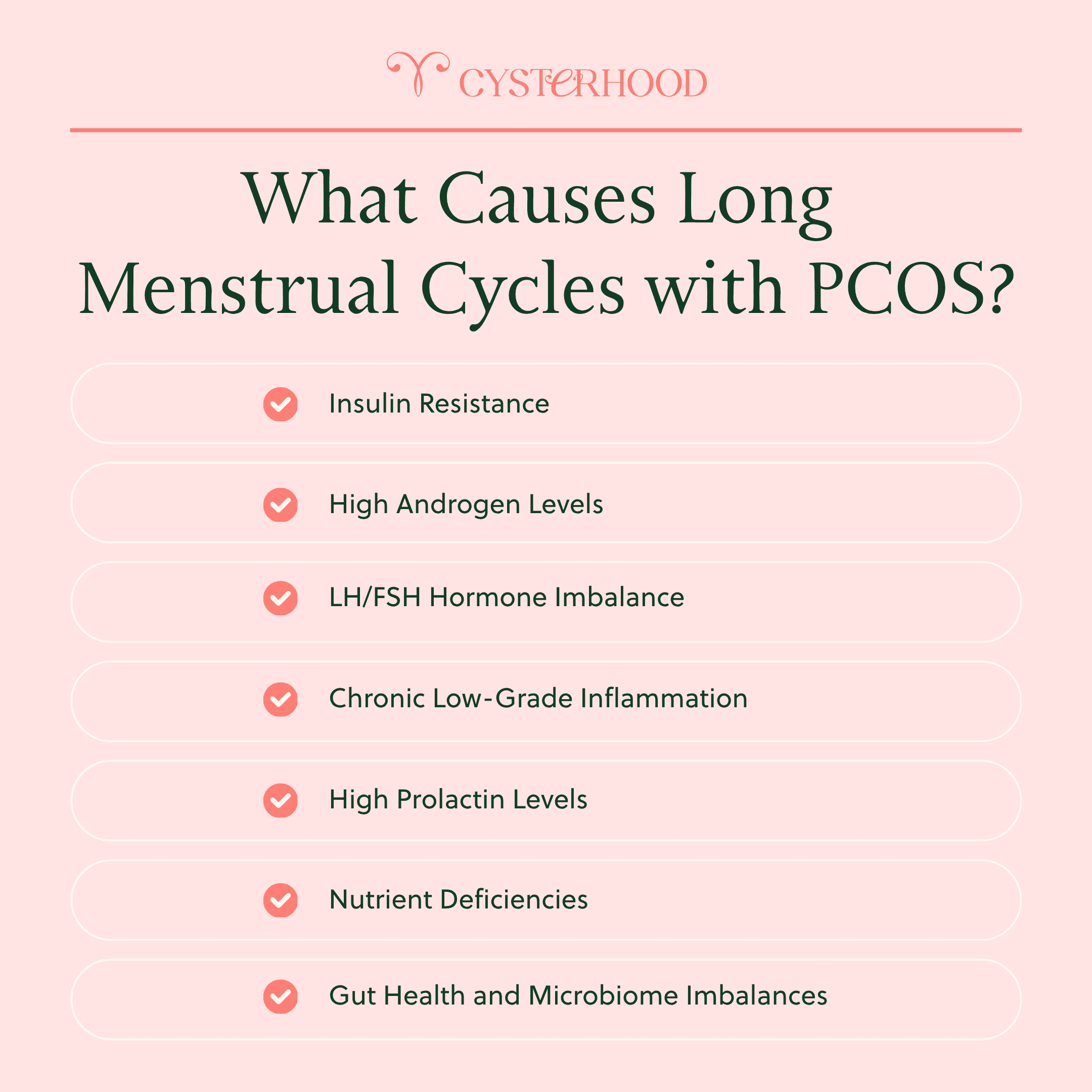
What Causes Long Menstrual Cycles with PCOS?
Insulin Resistance
Most women with PCOS have insulin resistance, which is when your body doesn’t properly convert glucose into energy. Instead, it stores it as fat, especially around the abdomen (also what’s referred to as “PCOS belly”). This impacts your metabolism, of course. But it also signals your ovaries to produce more androgens. That can disrupt follicle development, preventing you from ovulating when you’re supposed to.
High Androgen Levels
PCOS is a hormonal condition, and one of the primary hormones affected is androgens (male sex hormones). On top of that, insulin resistance just makes the imbalance worse. These high levels of androgens cause multiple follicles to form in your ovaries during the follicular phase, rather than one mature egg. (This creates the “polycystic” appearance of your ovaries on an ultrasound.)
Since there’s no dominant follicle, your body doesn’t get the signal to ovulate, leaving you “stuck” in the follicular phase. Without ovulation, your body doesn’t release an egg into the fallopian tube. This is how high male sex hormones can lead to anovulation, missed periods, late periods, and generally irregular cycles.
LH/FSH Hormone Imbalance
High androgens aren’t the only thing that impedes proper follicle development. Cysters often have elevated luteinizing hormone (LH) levels compared to their follicle-stimulating hormone (FSH). This imbalance overstimulates the ovaries, leading to multiple immature follicles developing instead of a single mature antral follicle. Because of that, both these hormones can lead to longer cycles.
High Prolactin Levels
You may have heard about prolactin in breastfeeding circles. Yes, it is responsible for milk production, but it’s also a key reproductive hormone. When prolactin levels are high, your body can act like it’s in a postpartum state instead of a prenatal state. This interferes with the proper release of LH and FSH needed for ovulation, furthering dysfunction in the follicular phase.
To learn more, here’s what you need to know about prolactin levels in PCOS.
Chronic Low-Grade Inflammation
Women with PCOS deal with three primary root issues behind their symptoms: insulin resistance, hormonal imbalance, and inflammation. When you experience chronic inflammation, your body is essentially stuck in emergency mode, preparing to fight off a perceived “threat.” But the threat is the PCOS dysfunction itself, meaning inflammation lingers longer than it should.
Since your body is preparing for the worst, it can stop prioritizing reproduction. Proper communication between your hormones and ovaries gets disrupted, insulin resistance worsens, and your menstrual cycle becomes irregular.
Nutrient Deficiencies
Nutrient deficiencies can make it harder for your body to produce and regulate hormones properly. Key nutrients like magnesium, zinc, B vitamins, and vitamin D all play a role in ovulation and cycle regulation. When your body lacks these, follicle development and hormone signaling can become impaired. This can delay ovulation and negatively affect your menstrual cycle overall.
Gut Health and Microbiome Imbalances
Your gut plays a major role in hormone balance, especially when it comes to metabolizing estrogen. When your gut microbiome is out of balance, your body may struggle to properly regulate hormone levels. This can contribute to inflammation, worsen insulin resistance, and disrupt ovulation signals. As a result, your cycle may become longer and lead to more irregular menstrual cycles.
Digestive issues are actually pretty common in Cysters. Here’s more on gut health and PCOS.
Is Having a Long Menstrual Cycle Bad?
Not necessarily, but it can be a sign that something’s off. If your cycles are around 31 days (or even a little longer), but they’re regular and predictable, it’s usually not a cause for concern. And occasionally having a late period due to stress, routine changes, or illness is pretty common.
However, if your cycles are consistently longer than 35 days and highly irregular, something isn’t right. This usually means an underlying factor is delaying or preventing ovulation, and it’s important to work with a doctor to figure out the cause. Irregular periods don’t just mean a “break” from menstruating. They often lead to infertility, more intense period symptoms, and deeper hormonal imbalances driving your PCOS.
For more information, read my post “What Are Periods Like with PCOS?” And while we’re at it, let’s debunk a common misconception by answering the question: Can sex change your menstruation cycle?
Does Long Menstrual Cycle Affect Fertility?
Yes, it can. A long menstrual cycle usually means delayed or non-existent ovulation, and you need to ovulate to get pregnant.
If you’re only ovulating every once in a while, you have fewer opportunities to conceive. And if ovulation isn’t happening at all, pregnancy isn’t possible in that cycle. On top of that, the same hormonal imbalances causing long cycles (like high androgens or insulin resistance) can also make it harder for your body to support healthy fetal development.
So, a long cycle doesn’t mean you can’t get pregnant. But it can make it a lot more difficult. The goal is to regulate your cycle so that ovulation happens consistently.
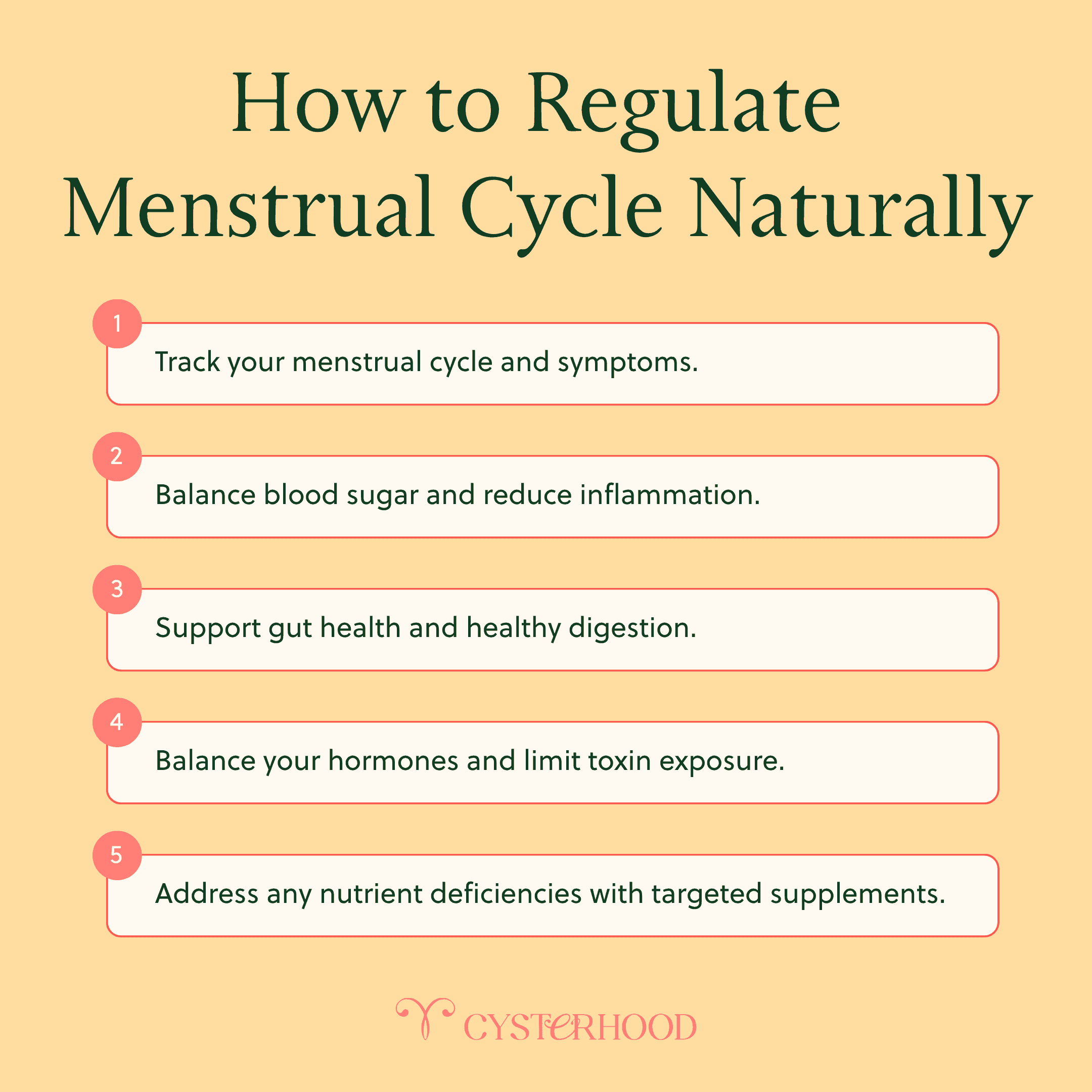
How to Regulate Menstrual Cycle Naturally
There’s a lot you can do to manage your PCOS symptoms naturally. Irregular cycles included! Below, I’ll break down some of my best tips to help you ease inflammation, reduce insulin resistance, and, most importantly, balance hormones.
This list may seem overwhelming at first, but just take it one step at a time. Don’t try to make all the changes at once! With the right lifestyle shifts and a little patience, you’ll see improvements not just in your cycles, but in all your PCOS symptoms.
Step One: Track your menstrual cycle and symptoms.
- Track cycle length, symptoms, and patterns: Record when your period starts and ends each month and note any recurring symptoms. This will help you identify patterns and see your progress.
- Note ovulation signs (like cervical mucus or basal body temperature): Pay attention to physical changes that can indicate if and when you are ovulating.
- Use an app or journal to stay consistent: Track your cycle daily using a method you can stick with so you can easily spot trends.
For more help, here’s how to track ovulation with irregular periods.
Step Two: Balance blood sugar and reduce inflammation.
- Try a gluten- and dairy-free anti-inflammatory diet: Focus on whole, nutrient-dense foods to help reduce inflammation and support hormone balance. Excessive consumption of junk food and other inflammatory foods can worsen all your PCOS symptoms. Here’s how the right foods can help heal your body.
- Cut back on alcohol: Reducing alcohol intake can help stabilize blood sugar and prevent added hormonal disruption.
- Opt for slow-weighted workouts: Choose strength training and low-impact movement to improve insulin sensitivity without increasing stress hormones. If you’re wondering why I recommend these types of exercises, listen to this episode of A Cyster and Her Mister.
- Stay hydrated: Drinking enough water supports your metabolism, helps regulate hormones, and keeps your body functioning optimally.
Find tons of PCOS-friendly recipes, workout routines, and resources on The Cysterhood app.
Step Three: Support gut health and healthy digestion.
- Consider taking probiotics: A quality probiotic can help support a healthy gut microbiome and improve overall hormone balance.
- Eat fiber-rich, whole foods: Fiber supports digestion and helps regulate blood sugar and estrogen levels.
- Include fermented foods: Foods like kombucha, kefir, sauerkraut, and kimchi introduce beneficial bacteria to support gut health.
- Reduce ultra-processed foods and added sugars: Cutting back on these can lower inflammation and prevent gut imbalances.
- Support digestion with mindful eating: Eating slowly and chewing thoroughly helps your body properly break down and absorb nutrients.
Step Four: Balance your hormones and limit toxin exposure.
- Avoid caffeine: Limiting caffeine can help reduce cortisol spikes and support more stable hormone levels.
- Drink Testosterone Relief Tea: This beneficial tea blend can help lower androgen levels and promote overall hormone balance with just two cups a day!
- Get better sleep: Practice better sleep hygiene to support hormone regulation, insulin sensitivity, and inflammation management.
- Reduce stress and practice self-care: Managing stress can help prevent hormonal disruptions that can delay ovulation.
- Avoid endocrine-disrupting chemicals: Reducing exposure to toxins (like BPA and phthalates) can help protect your hormonal balance. Here’s how to remove endocrine disruptors, if you’re new to it!
Step Five: Address any nutrient deficiencies with targeted supplements.
- Talk to your doctor about potential nutrient deficiencies: Lab testing can help identify gaps in key vitamins and minerals that support hormone health. Instead of guessing, this allows you to take a targeted approach and focus on what your body actually needs for better cycle regulation.
- Consider the following, research-backed supplements:
- Inositol Complete 40:1: Supports insulin sensitivity and helps regulate reproductive hormones
- Berberine Advanced: Helps balance blood sugar and reduce insulin resistance
- Meta Multivitamin: Provides essential nutrients to support overall health
- Meta Omega: Helps reduce inflammation and support hormone balance
- CoQ10: Supports egg quality and cellular energy production
- Curcumin: Acts as a powerful anti-inflammatory to help reduce underlying PCOS-related inflammation
Regulate PCOS menstrual cycles one lifestyle change at a time.
Long menstrual cycles with PCOS can feel frustrating, but they are also a clear signal from your body that something needs support. The good news is that when you address root causes like insulin resistance, inflammation, and hormone imbalances, you can start regulating your cycle naturally.
Small, consistent changes in your lifestyle, nutrition, and habits can make a meaningful difference over time. Focus on progress, not perfection, and give your body the support it needs to function properly. With the right approach, a regular, healthy cycle is absolutely possible.
Feeling lost with PCOS?
Find out your PCOS type and get your next steps in under 2 minutes.
Find My PCOS Type →